THE FOSSIL INVERTEBRATE MARINE FAUNA OF THE GAIMAN FORMATION (LOWER MIOCENE) AT BRYN GWYN (CHUBUT, PATAGONIA, ARGENTINA)
La fauna de invertebrados marinos fósiles de la Formación Gaiman (Mioceno inferior) en Bryn Gwyn (Chubut, Patagonia, Argentina)
DOI:
https://doi.org/10.5710/PEAPA.30.01.2026.557Keywords:
Bivalvia, Gaiman Formation, Gastropoda, Invertebrates, MioceneAbstract
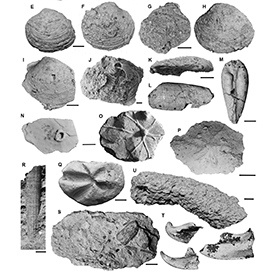
The Bryn Gwyn (Chubut Province, Patagonia, Argentina) is a classic fossiliferous site, long recognised for its Cenozoic vertebrate record. However, its invertebrate content remains poorly documented. The Lower Miocene Gaiman Formation, representing the “Patagonian Transgression”, has yielded abundant vertebrates, whereas invertebrate faunas were historically mentioned only briefly, mostly as molds. New material was collected following the most recent stratigraphical framework at the Bryn Gwyn locality. Fossiliferous levels were identified, and several specimens were described and studied using updated systematic arrangements. The Bryn Gwyn fossil invertebrate assemblage previously comprised only 11 taxa and a few higher-level groups. Our new study documents 27 genera or species-level taxa, nearly doubling the known diversity. A new species, namely Buccinanops halleri sp. nov., is also described. Several groups previously reported without precise determinations (e.g., bryozoans, gastropods, irregular echinoids) are now taxonomically resolved, and two additional higher-level groups, Brachiopoda and Scaphopoda, are recorded for the first time in the region. Comparisons with other Patagonian Cenozoic assemblages reveal strong faunal affinities with the time-equivalent Chenque and Monte León formations. These results substantially refine the taxonomic composition of the Bryn Gwyn invertebrate fossil fauna and provide a stronger basis for its inclusion in regional biostratigraphic correlations and paleoenvironmental reconstructions of the “Patagonian Transgression”.
References
Agnolin, F., Bogan, S., Lucero, S., Chimento, N. R., Santelli, M. B., Álvarez, M. J., Pérez, D., & Gambetta, D. H. (2024). Vertebrados e invertebrados fósiles en la Costa Atlántica de la provincia de Buenos Aires, Argentina: Edad y paleoambientes. Acta Geológica Lilloana, 35(1), 37–99.
Aguirre, M. L., & Farinati, E. A. (2000). Moluscos marinos del Cuaternario de Argentina. Boletín de la Academia Nacional de Ciencias, 64, 236–333.
Aguirre, M. L., Richiano, S., & Sirch, Y. N. (2006). Palaeoenvironments and palaeoclimates of the Quaternary molluscan faunas from the coastal area of Bahía Vera–Camarones (Chubut, Patagonia). Palaeogeography, Palaeoclimatology, Palaeoecology, 229(4), 251–286.
Aguirre-Urreta, M. B. (1990). Nuevos crustáceos decápodos (Brachyura y Anomura) en el Terciario de Patagonia, Argentina. Serie Correlación Geológica, 7, 5° Congreso Argentino de Paleontología y Bioestratigrafía, Actas I, 149–154.
Allende Mosquera, A., Cuitiño, J. I., & Espinosa, M. A. (2023). Fossil diatom study reveals significant freshwater input in Miocene coastal marine environments of the southwestern Atlantic (Patagonia, Argentina). Ameghiniana, 60(4), 342–357. https://doi.org/10.5710/AMGH.03.03.2023.3517
Allmon, W. D., & Knight, J. L. (1993). Paleoecological significance of a turritelline gastropod-dominated assemblage in the Cretaceous of South Carolina. Journal of Paleontology, 67(3), 355–360.
Álvarez, M. J. (2019). Phylogenetic analysis of the genus Retrotapes del Río, 1997 (Bivalvia: Veneridae) and systematic analysis of its taxa from Chile. Journal of Paleontology, 93(4), 685–701.
Álvarez, M. J., del Río, C. J., & Martínez, S. (2020). Revision of the subfamily Pitarinae Stewart, 1930 (Eucallista Dall, 1902; Austrocallista Erdmann & Morra, 1985; Proteopitar gen. nov.) from Cenozoic southern South America: Systematic and phylogenetic analyses. Journal of Systematic Palaeontology, 18(5), 433–460.
Ameghino, F. (1901). L’age des formations sédimentaires de Patagonie. Anales de la Sociedad Científica Argentina, 52, 189–197.
Bałuk, W., & Radwański, A. (1982). Middle Miocene (Badenian) free-living bryozoans from the Vienna Basin. Annalen des Naturhistorischen Museums in Wien. Serie A für Mineralogie und Petrographie, Geologie und Paläontologie, Anthropologie und Prähistorie, 86, 13–40.
Bellosi, E., & Barreda, V. D. (1993). Secuencias y palinología del Terciario medio en la Cuenca San Jorge: Registro de oscilaciones eustáticas en Patagonia. In 12° Congreso Geológico Argentino y 2° Congreso de Exploraciones de Hidrocarburos (Vol. 1, pp. 78–86).
Bengtson, P. (1988). Open nomenclature. Palaeontology, 31(1), 223–227.
Best, M. M., & Kidwell, S. M. (2000). Bivalve taphonomy in tropical mixed siliciclastic–carbonate settings. I. Environmental variation in shell condition. Paleobiology, 26(1), 80–102.
Blainville, H. M. D. de. (1814). Sur la classification méthodique des animaux mollusques, et établissement d'une nouvelle considération pour y parvenir. Bulletin des Sciences, par la Société Philomatique de Paris, 175–180.
Bostelmann, E., Ugalde, R., Oyarzún, J., & Griffin, M. (2015). The Patagonian transgression, early Miocene (Burdigalian age), in Aysén and Magallanes. In Actas del XIV Congreso Geológico Chileno (Vol. 1, pp. 825–828).
Brito, C. (2009). Evolución de las comunidades de organismos incrustantes y perforantes asociadas a arrecifes de ostras gigantes del Paleógeno y Neógeno de Patagonia, Argentina (Tesis de licenciatura). Facultad de Ciencias Exactas y Naturales, Universidad Nacional de La Pampa.
Bronn, H. G. (1862). Die Klassen und Ordnungen der Weichthiere (Malacozoa), wissenschaftlich dargestellt in Wort und Bild. Dritten Bandes erste Abtheilung. Kopflose Weichthiere (Malacozoa Acephala) Weichthiere. Leipzig: C. F. Winter.
Brunet, R. F. (1995). New species of Mollusca from the Entrerriense Formation (Upper Miocene) of Chubut Province, Argentina, and species not previously reported from the formation. Part I – Gastropoda and Scaphopoda. Tulane Studies in Geology and Paleontology, 28(1–2), 1–56.
Buono, M. R., Fernández, M. S., Cozzuol, M. A., Cuitiño, J. I., & Fitzgerald, E. M. G. (2017). The early Miocene balaenid Morenocetus parvus from Patagonia (Argentina) and the evolution of right whales. PeerJ, 5, e4148.
Busk, G. (1852). An account of the Polyzoa, and sertularian zoophytes, collected in the voyage of the Rattlesnake, on the coasts of Australia and the Louisiade Archipelago. In J. MacGillivray (Ed.), Narrative of the voyage of H.M.S. Rattlesnake (Vol. 1, pp. 343–402). London: T. & W. Boone.
Cabrera, A. (1928). Notas sinonímicas sobre algunas ostras fósiles sudamericanas. Revista Chilena de Historia Natural, 32, 13–21.
Camacho, H. H. (1974). Bioestratigrafía de las formaciones marinas del Eoceno y Oligoceno de la Patagonia. Anales de la Academia Nacional de Ciencias Exactas, Físicas y Naturales de Buenos Aires, 26, 39–57.
Camacho, H. H. (1981). Neovenericor, un sinónimo de Venericardia (Venericor) (Mollusca, Bivalvia). Revista de la Asociación Geológica Argentina, 36(3), 312–318.
Camacho, H. H., & Fernandez, J. A. (1956). La transgresión patagoniense en la costa atlántica entre Comodoro Rivadavia y el curso inferior del río Chubut. Revista de la Asociación Geológica Argentina, 11(1), 23–45.
Camacho, H. H., & Zinsmeister, W. (1989). La Familia Struthiolariidae Fischer, 1884 (Mollusca: Gastropoda) y sus representantes del Terciario Patagónico. Actas 48 Congreso Argentino de Paleontología y Bioestratigrafía (Mendoza, 4), 99–110.
Canu, F. (1904). Les bryozoaires du Patagonien. Échelle des bryozoaires pour les terrains tertiaires. Mémoires de la Société Géologique de France: Paléontologie, 12, 1–30.
Carmona, N. B., Mángano, M. G., Buatois, L. A., & Ponce, J. J. (2007). Bivalve trace fossils in an early Miocene discontinuity surface in Patagonia, Argentina: Burrowing behavior and implications for ichnotaxonomy at the firmground-hardground divide. Palaeogeography, Palaeoclimatology, Palaeoecology, 255(3–4), 329–341.
Casadío, S., & Griffin, M. (2009). Sedimentology and paleontology of a Miocene marine succession first noticed by Darwin at Puerto Deseado (Port Desire). Revista de la Asociación Geológica Argentina, 64(1), 83–89.
Casadío, S., Håkansson, E., Parras, A., & Griffin, M. (2005). Free-living bryozoans in the late Miocene Puerto Madryn Formation, Península Valdés: Paleoenvironmental and paleobiogeographical implications. Ameghiniana, 42(4 Suppl.), 20R.
Children, J. G. (1834). [Mollusca]. In Synopsis of the contents of the British Museum (ed. 28, pp. 88–118).
Cione, A. L. (1978). Aportes paleoictiológicos al conocimiento de la evolución de las paleotemperaturas en el área austral de América del Sur durante el Cenozoico. Aspectos zoogeográficos conexos. Ameghiniana, 15, 183–208.
Cione, A. L., & Azpelicueta, M. (2003). An Oplegnathid beak (Osteichthyes: Perciformes) from the Early Miocene of Patagonia. Extirpation of several vertebrates from southern Atlantic Ocean. Geobios, 36(5), 625.
Cione, A. L., Cozzuol, M. A., Dozo, M. T., & Acosta Hospitaleche, C. (2011). Marine vertebrate assemblages in the southwest Atlantic during the Miocene. Biological Journal of the Linnean Society, 103(2), 423–440.
Clench, W. J., & Turner, R. D. (1964). The subfamilies Volutinae, Zidoninae, Odontocymbiolinae and Callioctectinae in the western Atlantic. Johnsonia, 4(43), 129–179.
Closs, D., & Madeira, M. (1968). Cenozoic Foraminifera from the Chuy drill hole, northern Uruguay. Ameghiniana, 5, 229–246.
Conrad, T. A. (1841). Appendix to Mr. Hodge’s paper, describing the new shells. American Journal of Science, 41(2), 344–348.
Cook, P., & Chimonides, P. (1994). Notes on the family Cupuladriidae (Bryozoa), and on Cupuladria remota sp. n. from the Marquesas Islands. Zoologica Scripta, 23(3), 251–268.
Cossmann, M. (1898). Mollusques éocéniques de la Loire-inférieure. Appendice au second fascicule. Bulletin de la Société des Sciences Naturelles de l’Ouest de la France, 8, 1–55.
Cossmann, M. (1901). Essais de Paléoconchologie Comparée (Vol. 4). N.p., Paris. 293 pp.
Cotton, B. C., & Godfrey, F. K. (1938). A systematic list of the gastropoda the marine, freshwater and land univalve mollusca of south and central Australia. Adelaide: Malacological Society of South Australia. 44 pp.
Cox, L. R. (1960). Thoughts on the classification of the Gastropoda. Proceedings of the Malacological Society of London, 33(6), 239–261.
Cuitiño, J. I., Scasso, R. A., Ventura Santos, R., & Mancini, L. (2015a). Sr ages for the Chenque Formation in the Comodoro Rivadavia region (Golfo San Jorge Basin, Argentina): Stratigraphic implications. Latin American Journal of Sedimentology and Basin Analysis, 22, 3–12.
Cuitiño, J. I., Ventura Santos, R., & Alonso Muruaga, P. J., & Scasso, R. A. (2015b). Sr-stratigraphy and sedimentary evolution of early Miocene marine foreland deposits in the northern Austral (Magallanes) Basin, Argentina. Andean Geology, 42(3), 364–385.
Cuitiño, J. I., Buono, M. R., Viglino, M., Farroni, N., & Bessone, S. (2019). Factors affecting the preservation and distribution of cetaceans in the lower Miocene Gaiman Formation of Patagonia, Argentina. Palaeogeography, Palaeoclimatology, Palaeoecology, 526, 110–125.
Cuitiño, J. I., Bilmes, A., Buono, M. R., Bordese, S., Herazo, L., & Scasso, R. A. (2023). Stratigraphy, provenance, and timing of Neogene sedimentation in the western Valdés Basin, Patagonia. Accurate paleogeographic reconstructions as a key piece for andean-passive margin integration. Journal of South American Earth Sciences, 124, 104278. https://doi.org/10.1016/j.jsames.2023.104278
Cuitiño, J.I., Pérez, D.E., Farroni, N.D., Allende Mosquera, A., Viglino, M., Buono, M.R. & Scasso, R.A. (In press). Depositional environments, fossil content and stratigraphy of the Miocene marine succession at Bryn Gwyn and nearby localities, northeast Chubut, Patagonia, In: Buono, M.R. and Pérez, M.E. (Eds.) The Vertebrate Paleontology from the Cenozoic of Bryn Gwyn, Gaiman (Patagonia, Argentina). Springer Earth Systems Series.
Cuvier, G. (1795). Second Mémoire sur l'organisation et les rapports des animaux à sang blanc, dans lequel on traite de la structure des Mollusques et de leur division en ordre, lu à la société d'Histoire Naturelle de Paris, le 11 prairial an troisième. Magazin Encyclopédique. Journal des Sciences, des Lettres et des Arts, 2, 433–449.
d’Orbigny, A. D. (1834–1847). Voyage dans l'Amérique méridionale (le Brésil, la république orientale de l'Uruguay, la République argentine, la Patagonie, la république du Chili, la république de Bolivia, la république du Pérou), exécuté pendant les années 1826–1833. Tome 5(3) Mollusques. i–xliii, 1–758, 85 plates.
Dall, W. H. (1871). Report on the Brachiopoda of the Straits of Florida, in Charge of L. F. de Pourtales, with a Revision of the Craniidae and Discinidae Obtained by the U. S. Coast Survey Expedition. Bulletin of the Museum of Comparative Zoology at Harvard University, 3, 1–45.
Dall, W. H. (1907). A review of the American Volutidae. Smithsonian Miscellaneous Collections, 48, 341–373.
Dall, W. H. (1908). Reports on the dredging operations off the west coast of Central America to the Galapagos, to the west coast of Mexico, and in the Gulf of California, in charge of Alexander Agassiz, carried on by the U.S. Fish Commission steamer “Albatross,” during 1891, Lieut.-Commander Z.L. Tanner, U.S.N., commanding. XXXVII. Reports on the scientific results of the expedition to the eastern tropical Pacific, in charge of Alexander Agassiz, by the U.S. Fish Commission steamer “Albatross”, from October, 1904 to March, 1905, Lieut.-Commander L.M. Garrett, U.S.N., commanding. XIV. The Mollusca and Brachiopoda. Bulletin of the Museum of Comparative Zoology, 43(6), 205–487.
Dall, W. H. (1925). Notes on the Atlantic Coast species of Plicatula. Proceedings of the Biological Society of Washington.
Dana, J. D. (1852). Conspectus crustaceorum, &c. Conspectus of the Crustacea of the exploring expedition under Capt. C. Wilkes, U.S.N. Macroura. Proceedings of the Academy of Natural Sciences of Philadelphia, 6, 10–28.
Defrance, M. (1823). Polypiers. Dictionnaire des Sciences Naturelles, 26. Paris.
del Río, C. J. (1985). Primera mención de la subfamilia Architectonicinae (Mollusca: Gastropoda) en el Terciario de la Patagonia (República Argentina). Ameghiniana, 22(3–4), 263–268.
del Río, C. J. (1992). Middle Miocene Bivalves of the Puerto Madryn Formation, Valdés Peninsule, Chubut Province, Argentina (Nuculidae-Pectinidae), Part I. Palaeontographica Abteilung A, 225, 1–57.
del Río, C. J. (1997). Cenozoic biogeographic history of the eurothermal genus Retrotapes n. gen. (Subfamily Tapetinae) from Southern South America and Antarctica. The Nautilus, 110(3), 77–93.
del Río, C. J. (2004). Tertiary Marine molluscan assemblages of eastern Patagonia (Argentina): A biostratigraphic analysis. Journal of Paleontology, 78(6), 1097–1122. https://doi.org/10.1666/0022-3360(2004)078
del Río, C. J. (2021). Paleoclimate and changing composition of the Paleogene-Neogene shallow Molluscan Assemblages of Patagonia. Journal of South American Earth Sciences, 108, 103209.
del Río, C. J., & Camacho, H. H. (1998). Tertiary nuculoids and arcoids of Eastern Patagonia (Argentina). Palaeontographica, Abteilung A, 250, 47–88.
del Río, C. J., & Martínez, S. (1998). Clase Bivalvia. In C. del Río (Ed.), Moluscos Marinos Miocenos de la Argentina y Uruguay (Vol. 15, pp. 48–83). Buenos Aires: Academia Nacional de Ciencias Exactas, Físicas y Naturales.
del Río, C. J., & Martínez, S. (2006). The family Volutidae (Mollusca-Gastropoda) in the Tertiary of Patagonia (Argentina). Journal of Paleontology, 80, 919–945.
del Río, C. J., Martínez, S. A., & Scasso, R. A. (2001). Nature and origin of spectacular marine Miocene shell beds of northeastern Patagonia (Argentina): Paleoecological and bathymetric significance. Palaios, 16, 3–25.
del Río, C. J., Concheyro, A., & Martínez, S. (2011). The Maastrichtian–Danian at General Roca: A reappraisal of the chronostratigraphy and biostratigraphy of a type locality (Patagonia, Argentina). Neues Jahrbuch für Geologie und Paläontologie, 259, 129–156.
del Río, C. J., Martínez, S., Griffin, M., & De Francesco, C. G. (2022a). Moluscos y Equinodermos del Paleógeno-Neógeno. In R. Giacosa (Ed.), Relatorio del XXI Congreso Geológico Argentino, geología y Recursos Naturales de la Provincia del Chubut (pp. 1005–1028). Asociación Geológica Argentina.
del Río, C. J., Bellosi, E., McArthur, J., & Thirlwall, M. (2022). Early Miocene Sr-geochronology of Patagoniense marine units from southern Argentina: Implications for molluscan assemblages and interbasinal correlation. Journal of South American Earth Sciences, 120, 104097.
Deshayes, G. P. (1839). Nouvelles espèces de mollusques, provenant des côtes de la Californie, du Mexique, du Kamtschatka et de la Nouvelle-Zélande. Revue Zoologique par la Société Cuvierienne, 2(12), 356–361.
Desor, E. (1847). Sur quelques oursins fossiles de la Patagonie. Bulletin de la Société Géologique de France, Series 2, 4, 287–288.
DeVries, T. (2007). Cenozoic Turritellidae (Gastropoda) from Southern Peru. Journal of Paleontology, 81(2), 331–351.
Dillwyn, L. W. (1817). A descriptive catalogue of Recent shells, arranged according to the Linnean method; with particular attention to the synonymy (Vols. 1–2, pp. 1–1092 + index 29 pp.). John and Arthur Arch, London.
Düben, M. W. von, & Koren, J. (1846). Öfversigt af Skandinaviens Echinodermer [Overview of Scandinavian Echinodermata]. Kungl. Svenska Vetenskapsakademiens Handlingar, 1844, 229–328.
Duméril, A. M. C. (1805). Zoologie analytique, ou méthode naturelle de classification des animaux, rendue plus facile à l'aide de tableaux synoptiques. Paris: Allais. i–xxxiii + 1–344.
Erdmann, S., & Morra, G. A. (1985). Nuevos moluscos de la Formación San Julián, provincia de Santa Cruz. Ameghiniana, 22(3–4), 289–295.
Farroni, N. D., Cuitiño, J. I., Pérez, D. E., & Buono, M. R. (2023). Sedimentological and stratigraphically controlled preservation styles and distribution of fossil cetaceans from a new Early Miocene fossiliferous locality, Patagonia, Argentina. Historical Biology, 36(7), 1328–1342. https://doi.org/10.1080/08912963.2023.2212385
Feruglio, E. (1949). Descripción Geológica de la Patagonia (vols. 1–2). Ministerio de Industria y Comercio de La Nación, Dirección General de Yacimientos Petrolíferos Fiscales.
Figueiras, A. (1980). Los braquiópodos fósiles del Uruguay. Comunicación preliminar sobre los braquiópodos del Terciario. Resúmenes de las 1ras Jornadas de Ciencias Naturales, 1, 89–90. Montevideo.
Finlay, H. (1926). A further commentary on New Zealand molluscan systematics. Transactions of the New Zealand Institute, 57, 320–485.
Finlay, H. (1930). Invalid molluscan names. No. 1. Transactions of the New Zealand Institute, 61, 37–48.
Finlay, H., & Marwick, J. (1937). The Wangaloan and associated molluscan faunas of Kaitangata-Green Island subdivision. New Zealand Department of Scientific and Industrial Research, Geological Survey Branch, Palaeontological Bulletin, 15, 1–140.
Fischer, P. (1880–1887). Manuel de conchyliologie et de paléontologie conchyliologique, ou histoire naturelle des mollusques vivants et fossiles suivi d'un Appendice sur les Brachiopodes par D. P. Oehlert. Avec 23 planches contenant 600 figures dessinées par S. P. Woodward. Paris: F. Savy.
Frassinetti, D. (2001). Moluscos bivalvos y gastropodos del Mioceno marino de Isla Stokes, Sur de Chile. Boletín del Museo Nacional de Historia Natural, Chile, 50, 73–90.
Frassinetti, D. (2006). Moluscos fósiles del Mioceno marino de Islas Crosslet y Hereford (Golfo Tres Montes, Aisén, Chile). Boletín del Museo Nacional de Historia Natural de Chile, 55, 61–74.
Frassinetti, D., & Covacevich, V. (1999). Invertebrados fósiles marinos de la Formación Guadal (Oligoceno Superior–Mioceno Inferior) en Pampa Castillo, Región de Aisén, Chile. Servicio Nacional de Geología y Minería, Boletín, 51, 1–96.
Frenguelli, J. (1926). El Entrerriense de Golfo Nuevo en el Chubut. Boletín de la Academia Nacional de Ciencias, 29, 191–270.
Frenguelli, J. (1935). El perfil de Gaiman, Chubut. Notas del Museo de La Plata. Geología, 1, 177–192.
Friend, D., Anderson, B., Altier, E., Sang, S., Petsios, E., Portell, R., & Allmon, W. (2023). Systematics and phylogeny of Plio-Pleistocene species of Turritellidae (Gastropoda) from Florida and the Atlantic Coastal Plain. Bulletins of American Paleontology, 402, 1–74.
Galindo, L. A., Puillandre, N., Utge, J., Lozouet, P., & Bouchet, P. (2016). The phylogeny and systematics of the Nassariidae revisited (Gastropoda, Buccinoidea). Molecular Phylogenetics and Evolution, 99, 337–353.
Garvie, C. L. (1996). The molluscan macrofauna of the Reklaw Formation, Marquez Member (Eocene: Lower Claibornian), in Texas. Bulletins of American Paleontology, 111(352), 1–177.
Genge, M. C., Zattin, M., Witt, C., Derycke, A., Gautheron, C., Mazzoli, S., Petrelli, M., Cogné, N., Bosch, D., Bruguier, O., & Marquez, M. (2022). Denudation of the Cordillera and intraplate belt in Central Patagonia inferred by detrital multi-dating of foreland basin deposits. Sedimentary Geology, 440. https://doi.org/10.1016/j.sedgeo.2022.106237
Genta Iturrería, S., & Griffin, M. (2018). A review of the South American members of the family Struthiolariidae Fischer. Publicación Electrónica de la Asociación Paleontológica Argentina, 19(1), R52.
Gmelin, J. F. (1791). Vermes. In J. F. Gmelin (Ed.), Caroli a Linnaei Systema Naturae per Regna Tria Naturae (13th ed., Vol. 1(6), pp. 3021–3910). G.E. Beer.
Gravenhorst, J. L. C. (1843). Vergleichende Zoologie. Breslau: Graß, Barth & Comp.
Gray, J. E. (1840). Shells of molluscous animals. In Synopsis of the contents of the British Museum (pp. 105–152). G. Woodfall.
Gray, J. E. (1850). In M. E. Gray, Figures of molluscous animals, selected from various authors (Vol. 4, iv + 219 pp.). Longman, Brown, Green and Longmans, London.
Gray, J. E. (1854). Additions and corrections to the arrangement of the families of bivalve shells. The Annals and Magazine of Natural History, (2)14, 21–28.
Gray, J. E. (1855). Catalogue of the Recent Echinida, or Sea Eggs, in the Collection of the British Museum. Part I.-Echinida Irregularia. Woodfall & Kinder.
Griffin, M., & Nielsen, S. (2008). A revision of the type specimens of Tertiary molluscs from Chile and Argentina described by d’Orbigny (1842), Sowerby (1846) and Hupé (1854). Journal of Systematic Palaeontology, 6(3), 251–316. https://doi.org/10.1017/s1477201907002374
Griffin, M., & Pastorino, G. (2013). Cenozoic Ampullinidae and Naticidae (Mollusca, Gastropoda) from Patagonia, Argentina. Journal of Paleontology, 87, 502–525.
Guilding, L. (1834). Observations on Naticina and Dentalium, two genera of molluscous animals. Transactions of the Linnean Society of London, 17(1), 29–35.
Haller, M. J., & Mendía, J. E. (1980). Las sedimentitas del ciclo Patagoniano en el litoral atlántico norpatagónico. In Actas del 8° Congreso Geológico Argentino (Vol. 3). San Luis.
Hyžný, M., & Klompmaker, A. (2015). Systematics, phylogeny, and taphonomy of ghost shrimps (Decapoda): a perspective from the fossil record. Arthropod Systematics & Phylogeny, 73(3), 401–437.
Ihering, H. von. (1896). Zur Kenntnis der südamerikanischen Voluta und ihrer Geschichte. Nachrichtsblätter Deutsche Malakozoologische Gesellschaft, 7, 93–99.
Ihering, H. von. (1897). Os molluscos dos terrenos terciarios da Patagonia. Revista do Museo Paulista, 2, 217–382.
Ihering, H. von. (1899). Die Conchylien der patagonischen Formation. Neues Jahrbuch für Mineralogie, Geologie und Palaeontologie, 2, 1–41.
Ihering, H. von. (1903). Les brachiopodes tertiaires de Patagonie. Annales du Musée National de Buenos Aires (Serie 3°, II), 9, 321–349.
Ihering, H. von. (1904). Nuevas observaciones sobre moluscos cretáceos y terciarios de Patagonia. Revista del Museo de La Plata, XI, 229–243.
Ihering, H. von. (1907). Les Mollusques fossiles du Tertiaire et du Cretace Superieur de l’Argentine. Anales del Museo Nacional de Buenos Aires (Serie 3), 14(7), 1–611.
Jeffreys, J. G. (1877). New and peculiar Mollusca of the order Solenoconchia procured during the Valorous expedition. Annals and Magazine of Natural History, (4)19, 154–158.
Kiener, L. C. (1834–1841). Spécies général et iconographie des coquilles vivantes (Vol. 9, Famille des Purpurifères, Deuxième partie).
King, P. P. (1832). Description of the Cirrhipeda, Conchifera and Mollusca, in a collection formed by the officers of H.M.S. Adventure and Beagle employed between the years 1826 and 1830 in surveying the southern coasts of South America, including the Straits of Magalhaens and the coast of Tierra del Fuego. Zoological Journal, 5(125), 332–349.
Klein, J. T. (1778). Naturalis Dispositio Echinodermatum. Accessit Lucubratiuncula de Aculeis Echinorum Marinorum et Specilegium de Belemnitis. Lipsiae: Officina Gleditschiana, xx + 278 pp., 54 pl.
Kronemberger, J. T., & Parras, A. (2024). Turritelline-dominated assemblages from the Monte León formation (Lower Miocene), Patagonia, Argentina: Paleoecological and paleoenvironmental implications. Ameghiniana, 61(2), 118–137.
Kronemberger, J. T., Cuitiño, J. I., & Parras, A. M. (2025). Neogene Litho and Chronostratigraphy in the Southwestern Margin of the Colorado Basin (Río Negro, Argentina): The Gran Bajo Del Gualicho Formation. Journal of South American Earth Sciences, 105369.
Lagaaij, R. (1952). The Pliocene Bryozoa of the Low Countries and their bearing on the marine stratigraphy of the North Sea region. Mededelingen van de Geologische Stichting, 5, 6–233.
Lahille, F. (1896). Variabilité et affinités du Monophora darwini. Revista del Museo de La Plata, 7, 411–444.
Lamarck, J. P. B. A. de. (1801). Systéme des animaux sans vertébres ou tableau général des classes, des orders et des genres de ces animaux. Paris.
Lamarck, J.-B. (M. de). (1809). Philosophie zoologique, ou exposition des considérations relatives à l'histoire naturelle des animaux (Tome premier, I–XXV, 1–428; Tome second, 1–475). Paris: Dentu & the author.
Lambert, J. (1905). Notes sur quelques Échinides éocéniques de l'Aude et de l'Hérault. In L. Doncieux, Catalogue descriptif des fossiles nummulitiques de l'Aude et de l'Hérault. Première Partie. Montagne Noire et Minervois (pp. 129–164). Annales de l'Université de Lyon, Nouvelle Série, I. Sciences, Médecine.
Latreille, P. A. (1802–1805). Histoire Naturelle, Générale et Particulière des Crustacés et des Insectes. Familles naturelles des genre. Paris: de L'imprimerie de F. Dufart, 14 vols., 413 pp.
Leach, W. E. (1813–1815). Crustaceology. In D. Brewster (Ed.), The Edinburgh Encyclopaedia (Vol. 7(1): 383–384 [1813]; 7(2): 385–437, 765–766 [1814]; 9(1): pl. CCXXI [1815]). Balfour, Edinburgh.
Leach, W. E. (1819). A list of invertebrate animals discovered by H. M. S. Isabella, in a voyage to the Arctic regions: corrected by W. E. Leach. Appendix II. In J. Ross, A voyage of discovery in His Majesty's ships Isabella and Alexander (1818) for the purpose of exploring Baffin's Bay and enquiring into the possibility of a northwest passage (pp. lxi–lxiv). London: John Murray.
Lech, R., Aceñolaza, F. G., & Grizinik, M. (2000). Icnofacies Skolithos-Ophiomorpha en el Neogeno del valle inferior del río Chubut, provincia del Chubut, Argentina. In F. G. Aceñolaza & R. Herbst (Eds.), El Neógeno de Argentina. Serie Correlación Geológica, 14, 147–161.
Levy, R. (1961). Sobre algunos Terebratellidae de Patagonia (Argentina). Ameghiniana, 2(5), 79–88.
Linnaeus, C. (1758). Systema naturae per regna tria naturae (Editio decima, reformata). Holmiae: Laurentii Salvii.
Linnaeus, C. (1764). Museum s:æ r:æ m:tis Ludovicæ Ulricæ reginæ svecorum, gothorum, vandalorumque &c. &c. &c. Holmiae [Stockholm], 720 + 120 pp.
Lopes, R. P., Simone, L. R., Dillenburg, S. R., Schultz, C. L., & Pereira, J. C. (2013). A middle Pleistocene marine molluscan assemblage from the Southern coastal plain of Rio Grande do Sul State, Brazil. Revista Brasileira de Paleontologia, 16(3), 343–360.
López Cabrera, M. I., & Olivero, E. (2021). Intraspecific variability in the Early Miocene struthiolariid gastropod Perissodonta ameghinoi (Ihering, 1897) from Tierra del Fuego, Argentina. Publicación Electrónica de la Asociación Paleontológica Argentina, 21(2), 34–52.
López-Gappa, J., Pérez, L. M., & Griffin, M. (2017). First record of a fossil selenariid bryozoan in South America. Alcheringa, 41(3), 365–368.
Lóven, H. (1847). Malacozoologi. Öfversigt af Kongliga Vetenskaps Akademiens Förhandlingar, 4, 175–199, pls. 2–6.
Martens, E. von. (1878). Ueber einige Conchylien aus den kälteren Meeresgegenden der südlichen Erdhälfte. Sitzungs-Berichte der Gesellschaft Naturforschender Freunde zu Berlin, 1878, 20–26.
Martínez, S. (1984). Amplaster coloniensis n. g. n. sp. (Echinoidea: Monophorasteridae) del Mioceno de Uruguay. In P. M. del Carmen (Ed.), Memoria III Congreso Latinoamericano de Paleontología (pp. 505–508). Instituto de Geología de la UNAM, Mexico, D.F.
Martínez, S., del Río, C. J., & Rojas, A. (2016). A Pleistocene (MIS 5e) mollusk assemblage from Ezeiza (Buenos Aires Province, Argentina). Journal of South American Earth Sciences, 70, 174–187.
Martínez, S., & del Río, C. J. (2017). A supplementary description of Brisaster iheringi (Spatangoida: Schizasteridae) from the Miocene of Patagonia, Argentina. Revista de Biología Tropical, 65(Suppl. 1), S137–S146.
Marwick, J. (1924). Palaeontological notes on some Pliocene Mollusca from Hawke’s Bay. Transactions and Proceedings of the New Zealand Institute, 55, 191–202.
MolluscaBase. (2025). MolluscaBase. Accessed at https://www.molluscabase.org on 2025-05-06. https://doi.org/10.14284/448
Mörch, O. A. L. (1852). Catalogus conchyliorum quae reliquit D. Alphonso d'Aguirra & Gadea Comes de Yoldi, Regis Daniae Cubiculariorum Princeps, Ordinis Dannebrogici in Prima Classe & Ordinis Caroli Tertii Eques. Fasc. 1, Cephalophora. Hafniae [Copenhagen]: L. Klein, 170 pp.
Morra, G. A., & del Río, C. J. (1987). La Subfamili Architectonicinae (Mollusca: Gastropoda) en el Patagoniano. Revista de la Asociación Geológica Argentina, 42, 82–91.
Nielsen, S. (2003). Die marinen Gastropoden (exclusive Heterostropha) aus dem Miozän von Zentralchile (Unpublished doctoral dissertation, Universität Hamburg). 229 pp.
Nielsen, S., & Frassinetti, D. (2007). The Neogene Volutidae (Gastropoda: Neogastropoda) from the Pacific Coast of Chile. Journal of Paleontology, 81(1), 82–102.
Nielsen, S., & del Río, C. J. (2022). A new name for Valdesia del Río 1985 (Cenozoic fossil Mollusca), junior homonym of Valdesia Maury, 1981 (extant Arachnida). The Nautilus, 136(3–4), 70.
d’Orbigny, A. (1842). Voyage dans l’Amerique meridionale (Le Brasil, l’Uruguay) exécuté pendant les années 1826–1833. Paleontologie et Geologie (1842, vol. 3); Mollusques (1846, Vol. 5).
d'Orbigny, A. (1851–1854). Paléontologie française, Terrains Crétacés, V, Bryozoaires.
Ortmann, A. E. (1897). On some of the larger oysters of Patagonia. The American Journal of Science, 4, 355–356.
Ortmann, A. E. (1900). Synopsis of the collections of Invertebrate fossils made by the Princeton Expedition to southern Patagonia. The American Journal of Science, 10, 368–381.
Ortmann, A. E. (1902). Tertiary Invertebrates. In W. B. Scott (Ed.), Reports of the Princeton University Expedition to Patagonia 1896–1899 (Vol. 4, Paleontology I, Part 2, pp. 32–45). Princeton, New Jersey: J. Pierpoint Morgan Publishing Foundation.
Palazzesi, L., Vizcaíno, S., Barreda, V., Cuitiño, J., Del Río, C., Goin, F., González Estebenet, M.S., Guler, M.V., Gandolfo, M.A., Kay, R., Parras, A., Reguero, M., Zamaloa, M. (2021). Reconstructing Cenozoic Patagonian biotas using multi-proxy fossil records. Journal of South American Earth Sciences, 112, 103513.
Panti, C., Cuitiño, J.I., Noetinger, S., Pérez, D., Tapia, M.J., Allende Mosquera, A., Gutiérrez, D.G., Barreda, V.D. & Palazzesi, L. (2025). Tropical seagrasses reached Patagonia during Miocene times. Communications Earth & Environment, 6(1), 564.
Paolucci, F., Buono, M. R., Fernández, M. S., & Cuitiño, J. (2021). Systematic revision of a Miocene sperm whale from Patagonia, Argentina, and the phylogenetic signal of tympano-periotic bones in Physeteroidea. Acta Palaeontologica Polonica, 66(1), 63–76.
Parras, A., & Casadío, S. (2006). The oyster Crassostrea? hatcheri, a physical ecosystem engineer from the Upper Oligocene–Lower Miocene of Patagonia, Southern Argentina. Palaios, 21(2), 168–186.
Parras, A. M., & Cuitiño, J. I. (2021). Revised chrono and lithostratigraphy for the Oligocene–Miocene Patagoniense marine deposits in Patagonia: implications for stratigraphic cycles, paleogeography, and major drivers. Journal of South American Earth Sciences, 110. https://doi.org/10.1016/j.jsames.2021.103327
Parras, A., Dix, G. R., & Griffin, M. (2012). Sr-isotope chronostratigraphy of Paleogene–Neogene marine deposits: Austral Basin, southern Patagonia (Argentina). Journal of South American Earth Sciences, 37, 122–135.
Pastorino, G., & Simone, L. R. L. (2021). Revision of the genus Buccinanops (Mollusca: Neogastropoda: Nassariidae), an endemic group of gastropods from the Southwestern Atlantic, including a new genus and accounts on the Buccinanopsinae classification. Journal of Zoological Systematics and Evolutionary Research, 59(6), 1209–1254.
Pérez, D., Alvarez, M., & Santelli, M. B. (2017). Reassessment of Neovenericor Rossi de García, Levy & Franchi, 1980 (Bivalvia: Carditidae) using a geometric morphometric approach, and revision of planicostate carditids from Argentina. Alcheringa: An Australasian Journal of Palaeontology, 41(1), 112–123.
Pérez, D. E., Farroni, N., Allende Mosquera, A., & Cuitiño, J. I. (2023). First discinid brachiopods (Brachiopoda: Lingulida) from the Cenozoic of Patagonia (Gaiman Formation, Lower Miocene, Argentina). Ameghiniana, 60(3), 203–215.
Pérez, D., Farroni, N., Allende Mosquera, A., & Cuitiño, J. I. (2024). Clusters of Discinisca messii (Brachiopoda, Lingulida) en la Formación Puerto Madryn (Mioceno Tardío, Chubut). Publicación Electrónica de la Asociación Paleontológica Argentina, 24(R3), R131.
Pérez, D. E., Cuitiño, J. I., & Soto, I. M. (2025). A new species of Neovenericor (Bivalvia: Carditidae) from Patagonia (Gaiman Formation, Argentina) and an evaluation of the presence of Neovenericor in the Early Miocene. Historical Biology (in press), 1–12. https://doi.org/10.1080/08912963.2025.2472452
Pérez, L. M., Griffin, M., & Manceñido, M. O. (2013). Los macroinvertebrados de la Formación Paraná: Historia y diversidad de la fauna bentónica del Mioceno marino de Entre Ríos, Argentina. Asociación Paleontológica Argentina, Publicación Especial, 14, 56–70.
Philippi, R. A. (1887). Los fósiles terciarios i cuartarios de Chile. Leipzig: Brockhaus, 256 pp.
Pilsbry, H. A. (1929). Neverita reclusiana (Desh.) and its allies. The Nautilus, 42(4), 109–113.
Piro, A., & Acosta Hospitaleche, C. (2022). A new petrel (Aves: Procellariidae) from the early Miocene of Patagonia (Argentina). Historical Biology, 34(1), 141–151.
Ponder, W. F. (1973). A review of the Australian species of Penion Fischer (Neogastropoda: Buccinidae). Journal of the Malacological Society of Australia, 2, 401–428.
Rafinesque, C. (1815). Analyse de la Nature ou Tableau de l’univers et des corps organisés. Palerme, 224 pp.
Reichler, V. A. (2010). Estratigrafía y paleontología del Cenozoico del Gran Bajo del Gualicho y Salinas del Gualicho, Argentina, y descripción de 17 especies nuevas. Andean Geology, 37(1), 177–219.
Reichler, V. A. (2011). Venericor (Neovenericor) (Mollusca: Bivalvia) en el Mioceno de Patagonia oriental. Historia Natural, Tercera Serie, 1(2), 49–63.
Rochebrune, A. T. de, & Mabille, J. (1885). Diagnoses de mollusques nouveaux, recueillis par les membres de la mission du Cap Horn et M. Lebrun, Préparateur au Muséum, chargé d'une mission à Santa-Cruz de Patagonie. Bulletin de la Société Philomathique de Paris, (7) 9(3), 100–111.
Rossi de García, E., Levy, R., & Franchi, M. R. (1980). Neovenericor n. gen. (Bivalvia) su presencia en el Miembro Monte León (Formación Patagonia). Revista de la Asociación Geológica Argentina, 35(1), 59–71.
Rossi, E., & Levy, R. (1989). Presencia de Amplaster n. sp. (Echinodermata, Clypeasteroidea) en el Terciario de Patagonia. In IV Congreso Argentino de Paleontología y Bioestratigrafía: Mendoza, Noviembre 23–27, 1986, Actas 4, pp. 89–92.
Sacco, F. (1897). I Molluschi dei terreni terziarii del Piemonte e della Liguria, Parte 23 (Ostreidae, Anomiidae, Dimyidae). Bollettino dei Musei di Zoologia ed Anatomia Comparata della R. Università di Torino, 12(298), 99–100.
Salvini-Plawen, L. (1980). A reconsideration of systematics in the Mollusca (Phylogeny and higher classification). Malacologia, 19(2), 249–278.
Santelli, M. B., & Del Río, C. J. (2014). Revisión de la Subfamilia Crassatellinae (Bivalvia: Crassatellidae) del Paleógeno—Neógeno de Argentina. Ameghiniana, 51(4), 311–332.
Saporiti, E. (1938). Revisión de las especies típicas de Ostrea fósiles del Cretáceo superior y Terciario de la República Argentina (Unpublished doctoral thesis). Facultad de Ciencias Exactas y Naturales, Universidad de Buenos Aires, 90 pp.
Scasso, R. A., & Bellosi, E. S. (2004). Cenozoic continental and marine trace fossils at the Bryn Gwyn paleontological park, Chubut. In R. A. Scasso & E. S. Bellosi (Eds.), Bryn Gwyn Guidebook. I International Congress on Ichnology (pp. 1–19). Trelew, Argentina.
Scasso, R. A., & Castro, L. N. (1999). Cenozoic phosphatic deposits in North Patagonia, Argentina: Phosphogenesis, sequencestratigraphy and paleoceanography. Journal of South American Earth Sciences, 12(5), 471–487. https://doi.org/10.1016/S0895-9811(99)00035-8
Schneider, J. A. (2002). Phylogeny of cardiid bivalves (cockles and giant clams): revision of the Cardiinae and the importance of fossils in explaining disjunct biogeographical distributions. Zoological Journal of the Linnean Society, 136, 321–369.
Schumacher, C. F. (1817). Essai d'un nouveau système des habitations des vers testacés. Copenghagen: Schultz, iv + 288 pp., 22 pls.
Simpson, G. G. (1935). Early and middle Tertiary geology of the Gaiman region, Chubut, Argentina. American Museum Novitates, 775, 1–29.
Smith, E. A. (1875). Descriptions of some new shells from Kerguelen's Island. Annals and Magazine of Natural History, ser. 4, 16(91), 67–73.
Sowerby, G. B. I. (1834). Characters of new species of shells contained in the collection formed by Mr. Cuming, chiefly on the western coast of South America and among the islands of the South Pacific Ocean. Proceedings of the Zoological Society of London, 1834, 68–72.
Sowerby, G. B. I. (1846). Description of the Tertiary fossil shells from South America. In C. Darwin (Ed.), Geological Observations on the volcanic Islands and parts of South America visited during the voyage of H.M.S. "Beagle" (Appendix, pp. 249–264). London: D. Appleton and Company.
Sowerby, G. B. II. (1860). Monograph of the genus Dentalium. In G. B. Sowerby II (Ed.), Thesaurus conchyliorum, or monographs of genera of shells, Vol. 3(20), 97–104, pl. 223–225. London: privately published.
Steinmann, G., & Wilckens, O. (1908). Kreide und Tertiärfossilien aus den Magellansländern, gesammelt von der Schwedischen Expedition 1895–1897. Arkiv für Zoologi, 4, 1–119.
Sterli, J., Vlachos, E., Cuitiño, J., & Cerda, I., Buono, M. (2025). Southernmost dermochelyid turtle from the Miocene. Ameghiniana, 62(4), 1–19.
Stoliczka, F. (1871). Paleontologica Indica: Cretaceous Fauna of Southern India. Memoirs of the Geological Survey of India, 3, 1–538.
Stuardo, J., & Villarroel, M. (1974). On some living and fossil volutes referred to Miomelon Dall, 1907 and Proscaphella von Ihering, 1907. The Veliger, 17(2), 139–154.
Tambussi, C. P., Degrange, F. J., & de Mendoza, R. S. (2023). “The present state of knowledge of the Cenozoic birds of Argentina" by Tonni 1980: four decades after. Publicación Electrónica de la Asociación Paleontológica Argentina, 23(1), 255–295.
Viglino, M., Buono, M. R., Gutstein, C., Cozzuol, M. A., & Cuitiño, J. I. (2018). A new dolphin from the early Miocene of Patagonia (Argentina): insights into the evolution of Platanistoidea in the Southern Hemisphere. Acta Palaeontologica Polonica, 63, 261–277. https://doi.org/10.4202/app.00441.2017
Viglino, M., Buono, M. R., Fordyce, R. E., Cuitiño, J. I., & Fitzgerald, E. M. G. (2019). Anatomy and phylogeny of the large shark-toothed dolphin Phoberodon arctirostris Cabrera, 1926 (Cetacea, Odontoceti) from the early Miocene of Patagonia (Argentina). Zoological Journal of the Linnean Society. https://doi.org/10.1093/zoolinnnean/zly053
Waagen, W. H. (1885). Salt Range fossils, vol. I, part 4. Productus Limestone fossils, Brachiopoda. Memoirs of the Geological Survey of India, Palaeontologia Indica (series 13), 5, 729–770.
Whitfield, R. P. (1865). Descriptions of new species of Eocene fossils. American Journal of Conchology, 1, 259–268.
Williams, A., Carlson, S., & Brunton, C. (2000). Linguliformea. In R. Kaesler (Ed.), Treatise on Invertebrate Paleontology, Part H [Brachiopoda (revised), Vol. 2: Linguliformea, Craniiformea, and Rhynchonelliformea (part)] (pp. H30–H146). Geological Society of America and University of Kansas Press.
Windhausen, A. (1921). Sobre un viaje de reconocimiento geológico a la parte Nordeste del Territorio del Chubut, con referencia especial a la cuestión de la provisión de agua de Puerto Madryn. Boletín del Ministerio de Agricultura de la Nación. Dirección General de Minas, Geología e Hidrología, 24(B), 1–72.
WoRMS Editorial Board. (2025). World Register of Marine Species. Available from https://www.marinespecies.org at VLIZ.
Accessed 2025-05-06. https://doi.org/10.14284/170
Zinsmeister, W. J., & Camacho, H. H. (1980). Late Eocene Struthiolariidae (Mollusca: Gastropoda) from Seymour Island, Antarctic Peninsula and their significance to the biogeography of early Tertiary shallow-water faunas of the Southern Hemisphere. Journal of Paleontology, 54, 1–14.
Additional Files
Published
Issue
Section
License
Copyright (c) 2026 Damián Eduardo Pérez, Mariel Ferrari, Nicolás Daniel Farroni, Aylén Allende Mosquera, José Ignacio Cuitiño

This work is licensed under a Creative Commons Attribution-NoDerivatives 4.0 International License.

Authors retain copyright and grant the journal right of first publication with the work simultaneously licensed under a Atribución/Reconocimiento 4.0 Internacional that allows others to share the work with an acknowledgement of the work's authorship and initial publication in this journal.

 0.299 Q3 | H Index 12
 CiteScore 2.2