A SMALL SYNSACRUM OF AN ENIGMATIC BIRD FROM THE EOCENE OF MARAMBIO (SEYMOUR) ISLAND: INSIGHTS INTO THE ANTARCTIC AVIFAUNA
Un pequeño sinsacro de un ave enigmática del Eoceno de la Isla Marambio (Seymour): Aportes a la avifauna antártica
DOI:
https://doi.org/10.5710/PEAPA.10.02.2026.565Keywords:
Cenozoic, Charadriiformes, Fossil avifauna, James Ross Basin, La Meseta Formation, Paleogene, Neornithes, NeognathaeAbstract
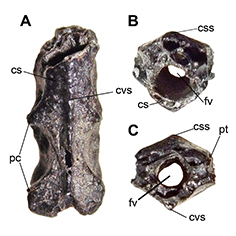
A small, incomplete synsacrum from Ypresian (early Eocene) levels of the Cucullaea I Allomember (La Meseta Alloformation) on Marambio (Seymour) Island, Antarctica, is examined. The synsacrum, which is dorsoventrally depressed and laterally widened, preserves two complete and one incomplete fused vertebrae. It exhibits a crista ventralis synsacri instead of the more typical sulcus ventralis synsacri observed in most Neornithes. Notable features include the presence of large, oval foramina intervertebralia that pierce the corpus synsacri and lateral concavities. Extensive comparisons with a broad sample of extant and extinct birds, including representatives of Tinamiformes, Anseriformes, Podicipediformes, Rallidae, Charadriiformes, Gaviiformes, Sphenisciformes, Procellariiformes, Phalacrocoracidae, Strigiformes, Accipitriformes, Phorusrhacidae, Falconiformes, and Pelagornithidae, reveal partial similarities with certain Charadriiformes but no exact match among the studied taxa. Given its unique combination of characters and its incomplete nature, the material is referred as an indeterminate Neognathae. Although a more precise taxonomic assignment is not possible, this synsacrum provides novel anatomical information as evidence of a small marine bird or shorebird in the Eocene of Antarctica. It underscores the significance of fragmentary postcranial elements in reconstructing past ecosystems and reveals a greater complexity in the structure of these avian communities than previously recognized.
References
Acosta Hospitaleche, C., & Gelfo, J. (2017). Procellariiform remains and a new species from the latest Eocene of Antarctica. Historical Biology, 29(6), 755–769.
Acosta Hospitaleche, C., & Jones, W. (2024). Were terror birds the apex continental predators of Antarctica? New findings in the early Eocene of Seymour Island. Palaeontologia Electronica, 27(1), 1–31.
Acosta Hospitaleche, C., Jadwiszczak, P., Clarke, J. A., & Cenizo, M. (2019). The fossil record of birds from the James Ross Basin, West Antarctica. Advances in Polar Science, 30(3), 251–273.
Acosta Hospitaleche, C. & Reguero, M. (2020). Additional Pelagornithidae remains from Seymour Island, Antarctica. Journal of South American Earth Sciences, 99, 102504.
Baumel, J. J., & Witmer, L. M. (1993). Osteologia. En J. J. Baumel, S. A. King, J. E. Breazile, H. E. Evans, & J. C. Berge (Eds.), Handbook of avian anatomy: Nomina anatomica avium (pp. 45–132). Publications of the Nuttall Ornithological Club.
Cenizo, M., Acosta Hospitaleche, C., & Reguero, M. (2015). Diversity of pseudo-toothed birds (Pelagornithidae) from the Eocene of Antarctica. Journal of Paleontology, 89, 870–881.
Degrange, F. J. (2012). Morfología del cráneo y complejo apendicular posterior de aves fororracoideas: implicancias en la dieta y modo de vida [Tesis Doctoral, Universidad Nacional de La Plata]. https://sedici.unlp.edu.ar/handle/10915/83640
Gardner, E. E., Walker, S. E., & Gardner, L. I. (2016). Paleoclimate, environmental factors, and bird body size: A multivariable analysis of avian fossil preservation. *Earth-Science Reviews, 162*, 177–197.
Jadwiszczak, P. (2006). Eocene penguins of Seymour Island, Antarctica: Taxonomy. Polish Polar Research, 27, 3–62.
Jadwiszczak, P. (2014). Synsacra of the Eocene Antarctic penguins: New data on spinal maturation and an insight into their role in the control of walking. Polish Polar Research, 35(1), 27–39.
Jadwiszczak, P., Reguero, M., & Mörs, T. (2021). A new small-sized penguin from the late Eocene of Seymour Island with additional material of Mesetaornis polaris. GFF, 143(2–3), 283–291. https://doi.org/10.1080/11035897.2021.1907444
Jadwiszczak, P., Svensson-Marcial, A., & Mörs, T. (2023). An integrative insight into the synsacral canal of fossil and extant Antarctic penguins. Integrative Zoology, 18(2), 237–253. https://doi.org/10.1111/1749-4877.12668
Kaiser, G. (2007). The inner bird: Anatomy and evolution. University of British Columbia Press.
Livezey, B. C., & Zusi, R. L. (2007). Higher-order phylogeny of modern birds (Theropoda, Aves: Neornithes) based on comparative anatomy. Zoological Journal of the Linnean Society, 149(1), 1–95.
Marenssi, S., Santillana, S., & Rinaldi, C. (1998a). Stratigraphy of La Meseta Formation (Eocene), Marambio Island, Antarctica. En S. Casadío (Ed.), Paleógeno de América Del Sur y de La Península Antártica. Revista de la Asociación Paleontológica Argentina, Publicación Especial 5 (pp. 137–146).
Marenssi, S. A., Santillana, S. N., & Rinaldi, C. A. (1998b). Paleoambientes sedimentarios de la Aloformación La Meseta (Eoceno), Isla Marambio (Seymour), Antártida. Instituto Antártico Argentino. (Contribución N° 464).
Mayr, G., & Rubilar-Rogers, D. (2010). Osteology of a new giant bony-toothed bird from the Miocene of Chile, with a revision of the taxonomy of Neogene Pelagornithidae. Journal of Vertebrate Paleontology, 30(5), 1313–1330.
Mayr, G., Goedert, J. L., & McLeod, S. A. (2013). Partial skeleton of a bony-toothed bird from the late Oligocene/early Miocene of Oregon (USA) and the systematics of Neogene Pelagornithidae. Journal of Paleontology, 87(5), 922–929.
Montes, M., Nozal, F., Santillana, S., Olivero, E., Gallastegui, G., Maestro, A., López-Martínez, J., González, L., & Martín-Serrano, A. (2013). Mapa geológico de Isla Marambio (Seymour), Antártida (Escala 1:20.000) (1ª ed.). Serie Cartográfica Geocientífica Antártica.
Montes, M., Nozal, F., Olivero, E., Gallastegui, G., Santillana, S., Maestro, A., López-Martínez, J., González, L., & Martín-Serrano, A. (2019). Geología y geomorfología de Isla Marambio (Seymour). En M. Montes & F. Nozal (Eds.), Geología y geomorfología de Isla Marambio (Seymour). Instituto Geológico y Minero de España; Instituto Antártico Argentino.
Myrcha, A., Jadwiszczak, P., Tambussi, C. P., Acosta Hospitaleche, C., & Reguero, M. (2002). Taxonomic revision of Eocene Antarctic penguins based on tarsometatarsal morphology. Polish Polar Research, 23(1), 5–46.
Necker, R. (2005). The structure and development of avian lumbosacral specializations of the vertebral canal and the spinal cord with special reference to a possible function as a sense organ of equilibrium. Anatomy and Embryology, 210(1), 59–74. https://doi.org/10.1007/s00429-005-0016-6
Necker, R. (2006). Specializations in the lumbosacral vertebral canal and spinal cord of birds: Evidence of a function as a sense organ which is involved in the control of walking. Journal of Comparative Physiology A: Neuroethology, Sensory, Neural, and Behavioral Physiology, 192(5), 439–448. https://doi.org/10.1007/s00359-005-0076-3
Additional Files
Published
Issue
Section
License
Copyright (c) 2026 María Alejandra Sosa, Carolina Acosta Hospitaleche

This work is licensed under a Creative Commons Attribution-NoDerivatives 4.0 International License.
Authors retain copyright and grant the journal right of first publication with the work simultaneously licensed under a Atribución/Reconocimiento 4.0 Internacional that allows others to share the work with an acknowledgement of the work's authorship and initial publication in this journal.

 0.299 Q3 | H Index 12
 CiteScore 2.2