AUTOMATED MULTI-VIEW SILHOUETTE GENERATION AND MORPHOMETRIC CLUSTERING OF ISOLATED THEROPOD TEETH USING MACHINE LEARNING
Generación automatizada de siluetas en múltiples vistas y agrupamiento morfométrico de dientes aislados de terópodos mediante aprendizaje automático
DOI:
https://doi.org/10.5710/Keywords:
Guimarota Theropoda isolated teeth, Semantic segmentation, Transfer learning, HDBSCAN, UMAP dimensionality reduction, Random forest, Convolutional neural networkAbstract
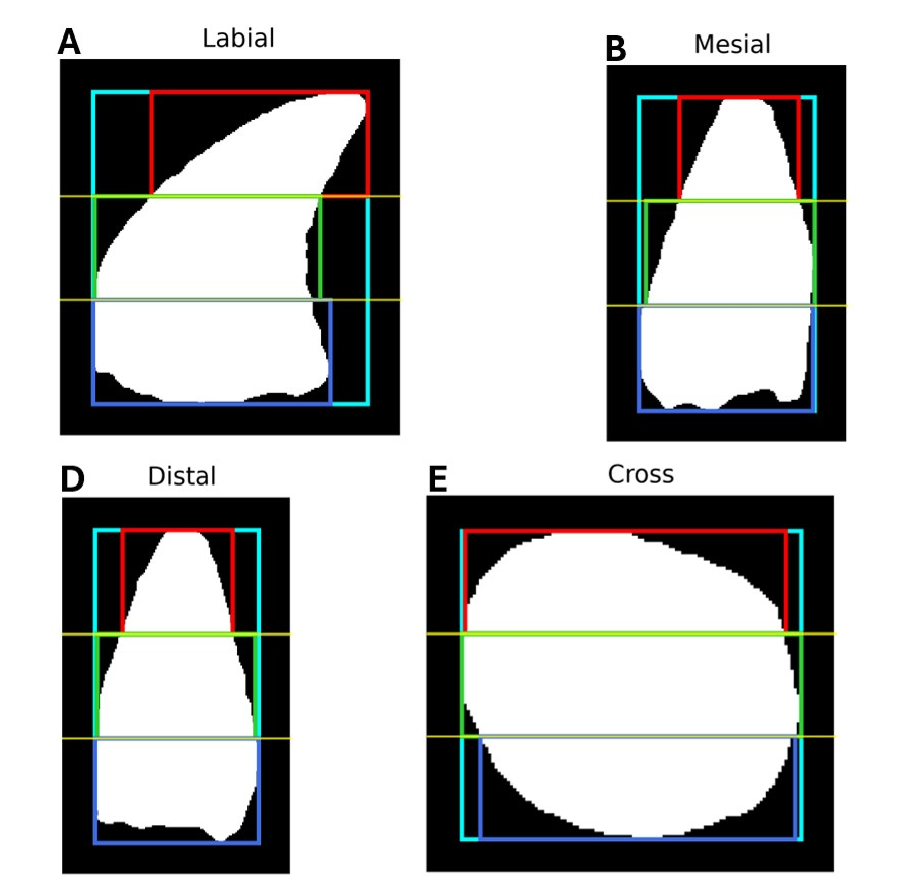
Isolated theropod teeth are abundant in mesozoic vertebrate assemblages and often taxonomically informative, but their description still relies on manual measurements and expert-defined characters. We present an automated computer-vision workflow that converts raw multi-view photographs of isolated theropod teeth into standardized binary silhouettes in labial, lingual, mesial, distal, and basal cross-sectional views. A segmentation model initialized from dinosaur-track image binarization was used and then finetuned on tooth-like shapes. The model was applied to 74 theropod teeth (10 for testing) from Guimarota, a Late Jurassic locality in Portugal, containing one of the most important assemblages of isolated small theropod teeth in Europe. From the silhouettes, we extracted width, height, and contour-angle descriptors from whole crown and upper, middle, and lower crown regions. Dimensionality reduction and density-based clustering (HDBSCAN) were used to explore the measurement space, and cluster assignments were interpreted with random forest feature importance and decision trees. The analysis used 64 independent teeth represented by 1280 derived view-region records; the most influential variables included height and width measurements. HDBSCAN identified five clusters and eleven unassigned specimens, suggesting morphological heterogeneity. Cluster-assigned silhouettes were then used to train an EfficientNet model on 53 assigned teeth. As an exploratory internal-consistency check, the model recovered cluster-derived classes with high
mean performance under repeated stratified cross-validation, although with some fold-to-fold variation, especially in the least represented cluster. Gradient-weighted Class Activation Mapping (Grad-CAM) highlighted anatomically meaningful silhouette regions, including apices, lateral contours, basal margins, and cross-sectional perimeter. This workflow provides a scalable framework for reproducible theropod tooth morphometrics.
References
Breiman, L. (2001). Random forests. Machine Learning 45:5–32. DOI: 10.1023/A:1010933404324.
Bradski, G. (2000). The OpenCV Library. Dr. Dobb’s Journal of Software Tools.
Chen, L.-C., Zhu, Y., Papandreou, G., Schroff, F., and Adam, H. (2018). Encoder-decoder with atrous separable convolution for semantic image segmentation. European Conference on Computer Vision. DOI: 10.1007/978-3-030-01234-2_49.
Deng, J., Dong, W., Socher, R., Li, L.-J., Li, K., and Fei-Fei, L. (2009). ImageNet: A large-scale hierarchical image database. Proceedings of the IEEE Conference on Computer Vision and Pattern Recognition (CVPR), 248–255. DOI: 10.1109/CVPR.2009.5206848.
Fürsich, F. T., Schneider, S., Werner, W., Lopez-Mir, B. and Pierce, C. S. (2022). Life at the continental–marine interface: palaeoenvironments and biota of the Alcobaça Formation, Late Jurassic, Central Portugal, with a formal definition of the unit appended. Palaeobiodiversity and Palaeoenvironments 102:1–52. DOI: 10.1007/s12549-021-00496-x
Gerke, O., and Wings, O. (2016). Multivariate and cladistic analyses of isolated teeth reveal sympatry of theropod dinosaurs in the Late Jurassic of Northern Germany. PLOS ONE 11:e0158334. DOI: 10.1371/journal.pone.0158334.
Hendrickx, C., Mateus, O., and Araújo, R. (2015). A proposed terminology of theropod teeth (Dinosauria, Saurischia). Journal of Vertebrate Paleontology 35:e982797. DOI: 10.1080/02724634.2015.982797.
Hendrickx C, Mateus O, Araújo R, Choiniere J. (2019). The distribution of dental features in non-avian theropod dinosaurs: taxonomic potential, degree of homoplasy, and major evolutionary trends. Palaeontologia Electronica 22(3):74 1–110. DOI:10.1016/j.cretres.2019.104312
Hendrickx, C., Tschopp, E. and d’Ezcurra, M. D. (2020). Taxonomic identification of isolated theropod teeth: the case of the Cretaceous Kem Kem Group of Morocco. Cretaceous Research 112:104415. DOI: 10.1016/j.cretres.2019.104312
Hendrickx, C., Trapman, T. H., Wills, S., Holwerda, F. M., Stein, K. H. W., Rauhut, O. W. M., Melzer, R. R., Van Woensel, J., and Reumer, J. W. F. (2024). A combined approach to identify isolated theropod teeth from the Cenomanian Kem Kem Group of Morocco: Cladistic, discriminant, and machine learning analyses. Journal of Vertebrate Paleontology, e2311791. DOI: 10.1080/02724634.2024.2311791
Iakubovskii, P. (2019). Segmentation Models Pytorch. GitHub repository. https://github.com/qubvel/segmentation_models.pytorch
Larson, D. W., and Currie, P. J. (2013). Multivariate analyses of small theropod dinosaur teeth and implications for paleoecological turnover through time. PLOS ONE 8:e54329. DOI: 10.1371/journal.pone.0054329.
Liu, X., Jiang, S., Wu, R., and Shu, W. (2023). Automatic taxonomic identification based on the Fossil Image Dataset (>415,000 images) and deep convolutional neural networks. Paleobiology 49:1–22. DOI: 10.1017/pab.2022.14.
Loshchilov, I., and Hutter, F. (2019). Decoupled weight decay regularization. ICLR. DOI: 10.48550/arXiv.1711.05101
Louchart, A., and Pouech, J. (2017). A tooth of Archaeopterygidae (Aves) from the Lower Cretaceous of France extends the spatial and temporal occurrence of the earliest birds. Cretaceous Research, 73, 40-46. DOI: 10.1016/j.cretres.2017.01.004
Marques, C. S., Dufourq, E., Pereira, S., Santos, V. F., and Malafaia, E. (2025). Enhancing the classification of isolated theropod teeth using machine learning: A comparative study. PeerJ, 13, e19116. DOI: 10.7717/peerj.19116
Martin, T. and Krebs, B. (2000). Guimarota: A Jurassic Ecosystem. Verlag Dr. Friedrich Pfeil, München. DOI: 10.1017/S0016756801316084
McInnes, L., Healy, J., and Astels, S. (2017). hdbscan: hierarchical density based clustering. Journal of Open Source Software 2:205. DOI: 10.21105/joss.00205.
McInnes, L., Healy, J., Saul, N., and Großberger, L. (2018). UMAP: Uniform Manifold Approximation and Projection. Journal of Open Source Software 3:861. DOI: 10.21105/joss.00861.
Murray, A., van Kemenade, H., Wiredfool, Clark, J. A., Karpinsky, A., Baranovič, O., Yay295, Gohlke, C., Dufresne, J., Brett, M., DWesl, Schmidt, D., Kopachev, K., Houghton, A., REDxEYE, Keith-Magee, R., Mani, S., Landey, S., Koskela, A., … Lahd, R. (2026). python-pillow/Pillow: 12.2.0 (Version 12.2.0). Zenodo. DOI: 10.5281/zenodo.19371132.
Nair, V., and Hinton, G. E. (2010). Rectified linear units improve restricted Boltzmann machines. ICML. DOI: 10.5555/3104322.3104425
Otsu, N. (1979). A threshold selection method from gray-level histograms. IEEE Transactions on Systems, Man, and Cybernetics, 9(1), 62–66. DOI: 10.1109/TSMC.1979.4310076
Pan, S. J., and Yang, Q. (2010). A survey on transfer learning. IEEE Transactions on Knowledge and Data Engineering 22:1345–1359. DOI: 10.1109/TKDE.2009.191.
Paszke, A., Gross, S., Massa, F., et al. (2019). PyTorch: An imperative style, high-performance deep learning library. NeurIPS. DOI: 10.48550/arXiv.1912.01703
Pedregosa, F., Varoquaux, G., Gramfort, A., et al. (2011). Scikit-learn: Machine learning in Python. Journal of Machine Learning Research, 12, 2825–2830. DOI: doi/10.5555/1953048.2078195
Python Software Foundation. (2022). Python 3.8.16.
Rauhut O, Martin T, Krebs B. 2000. The dinosaur fauna from the Guimarota mine. Guimarota—A Jurassic Ecosystem 75-82.
Russakovsky, O., Deng, J., Su, H., et al. (2015). ImageNet Large Scale Visual Recognition Challenge. International. DOI: 10.1007/s11263-015-0816-y
Selvaraju, R. R., Cogswell, M., Das, A., et al. (2017). Grad-CAM: Visual explanations from deep networks via gradient-based localization. ICCV. DOI: 10.1109/ICCV.2017.74
Serrano-Martínez, A., Vidal, D., Sciscio, L., Ortega, F., and Knoll, F. (2016). Isolated theropod teeth from the Middle Jurassic of Niger and the early dental evolution of Spinosauridae. Acta Palaeontologica Polonica, 61(2), 403–415. DOI: 10.4202/app.00101.2
Smith, J. B., and Dodson, P. (2003). A proposal for a standard terminology of anatomical notation and orientation in fossil vertebrate dentitions. Journal of Vertebrate Paleontology, 23(1), 1–12. DOI: 10.1671/0272-4634(2003)23[1:APFAST]2.0.CO;2
Smith, J. B., Vann, D. R., and Dodson, P. (2005). Dental morphology and variation in theropod dinosaurs: Implications for the taxonomic identification of isolated teeth. The Anatomical Record Part A, 285A, 699–736. DOI: 10.1002/ar.a.20206
Sola, J., and Sevilla, J. (1997). Importance of input data normalization for the application of neural networks to complex industrial problems. IEEE Transactions on Nuclear Science 44,3:1464-1468, DOI: 10.1109/23.589532
Tan, M., and Le, Q. V. (2019). EfficientNet: Rethinking model scaling for convolutional neural networks. Proceedings of ICML. DOI: 10.48550/arXiv.1905.11946
Wills, S., Underwood, C. J., and Barrett, P. M. (2021). Learning to see the wood for the trees: Machine learning, decision trees, and the classification of isolated theropod teeth. Palaeontology, 64(1), 75–99. DOI: 10.1111/pala.12512
van der Walt, S., Schönberger, J. L., Nunez-Iglesias, J., et al. (2014). scikit-image: Image processing in Python. PeerJ, 2, e453. DOI: 10.7717/peerj.453
Yu, C., et al. (2022). CT segmentation of dinosaur fossils by deep learning. Frontiers in Earth Science 9:805271. DOI: 10.3389/feart.2021.805271.
Yu, C., Qin, F., Watanabe, A., Yao, W., Li, Y., Qin, Z., ... and Xu, X. (2024). Artificial intelligence in paleontology. Earth-Science Reviews, 252, 104765. DOI: 10.1016/j.earscirev.2024.104765.
Zinke, J. (1998). Small theropod teeth from the Upper Jurassic coal mine of Guimarota, Portugal. Paläontologische Zeitschrift 72:179–189. DOI: 10.1007/BF02987825.
Additional Files
Published
Issue
Section
License
Copyright (c) 2026 Carolina S. Marques , Emmanuel Dufourq, Soraia Pereira, Vanda F. Santos, Elisabete Malafaia

This work is licensed under a Creative Commons Attribution-NoDerivatives 4.0 International License.
Authors retain copyright and grant the journal right of first publication with the work simultaneously licensed under a Atribución/Reconocimiento 4.0 Internacional that allows others to share the work with an acknowledgement of the work's authorship and initial publication in this journal.

 0.299 Q3 | H Index 12
 CiteScore 2.2