TYPE SPECIMENS OF FOSSIL FISHES AT THE MUSEO DE LA PLATA: A CATALOG
Especímenes tipo de peces fósiles en el Museo de La Plata: un catálogo
DOI:
https://doi.org/10.5710/PEAPA.16.06.2026.566Keywords:
Chondrichthyes, Actinopterygii, Sarcopterygii, Gondwana, South America, ArgentinaAbstract
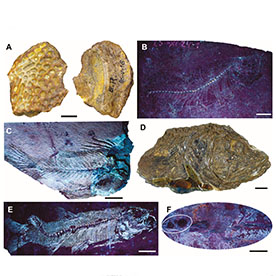
We present the first annotated and illustrated catalog of fossil fish type specimens that are housed in the División Paleontología Vertebrados of the Museo de La Plata, Argentina. The catalog comprises 31 type specimens (including 21 holotypes, five syntypes, two lectotypes, two paratypes, and one neotype), systematically arranged within a phylogenetic framework. For each taxon, we provide updated information on geographical and stratigraphical provenance, systematic placement, and type status. Relevant taxonomic or historical remarks are included where appropriate. This catalog serves as a critical resource for researchers by enhancing access to primary paleontological data and supporting future taxonomic, systematic, and biogeographical studies of fossil fishes. In addition to improving the visibility and usability of this historical collection, the catalog contributes to the preservation of essential type material in line with the International Code of Zoological Nomenclature (ICZN) guidelines. It also underscores the relevance of institutional efforts in curating and digitizing fossil collections as a foundation for global collaboration and renewed investigations into the evolutionary history of Gondwanan ichthyofaunas.
References
Acosta-Hospitaleche, C., Tambussi, C. P., & Reguero, M. A. (2001). Catálogo de los tipos de aves fósiles del Museo de La Plata. Serie Técnica y Didáctica del Museo de La Plata, 41, 1–28.
Agassiz, L. (1843). Recherches sur les poissons fossiles. Imprimerie de Petitpierre, 3, 336–358.
Aguirre-Urreta, M. B. (2002). Invertebrados del Cretácico Inferior. In M. J. Haller (Ed.), Geología y Recursos Naturales de Santa Cruz (pp. 439–460). Asociación Geológica Argentina.
Aldinger, H. (1937). Permische ganoidfische aus Ostgrönland. Meddelelser om Grønland, 102, 1–392.
Ameghino, F. (1898). Sinopsis geológico-paleontológica de la Argentina. Segundo Censo Nacional de la República Argentina, 1, 115–228.
Ameghino, F. (1899). Sinopsis geológica-paleontológica. Suplemento (adiciones y correcciones). Imprenta La Libertad, 1, 1–13.
Ameghino, F. (1900). L’âge des formations sédimentaires de Patagonie. Anales de la Sociedad Científica Argentina, 50, 145–165.
Ameghino, F. (1906). Les formations sédimentaires du Crétacé superieur et du Tertiaire de Patagonia, avec an paralèlle entre leurs faunes mammalogiques et celles de l’ancien continent. Anales del Museo Nacional de Buenos Aires, 15, 1–568.
Antunes, M. T., & Jonet, S. (1970). Requins de l'Helvétien supérieur et du Tortonien de Lisbonne. Revista da Facultad de Ciências de Lisboa, 16, 119–280.
Arcila, D., Ortí, G., Vari, R., Armbruster, J. W., Stiassny, M. L., Ko, K. D., Sabaj, M. H., Lundberg, J., Revell, L. J., & Betancur-R., R. (2017). Genome-wide interrogation advances resolution of recalcitrant groups in the tree of life. Nature Ecology & Evolution, 1, 1–10.
Arratia, G. (1982). A review of freshwater Percoids from South America (Pisces, Osteichthyes, Perciformes, Percichthydae, and Perciliidae). Abhandlungen der Senckenbergischen Naturforscheden Gesellschaft, 540, 1–52.
Arratia, G. (1987). Jurassic fishes from Chile and critical comments. In W. Volkheimer, & E. Musacchio (Eds.), Bioestratigrafía de los Sistemas Regionales del Jurásico y Cretácico en América del Sur. Vol. 1: Jurásico anterior a los movimientos intermálmicos (pp. 257–286). Comité Sudamericano del Jurásico y Cretácico.
Arratia, G. (1996). Basal teleosts and teleostean phylogeny. [PhD Thesis, Uppsala University]. https://doi.org/10.2307/1447369
Arratia, G. (1997). Basal teleosts and teleostean phylogeny. Paleo Ichthyologica, 7, 51–68. https://doi.org/10.2307/1447369
Arratia, G. (1999). The monophyly of Teleostei and stem-group teleosts. Consensus and disagreements. In G. Arratia, & H. P. Schultze (Eds.), Mesozoic Fishes 2. Systematics and the Fossil Record (pp. 265–334). Verlag Dr. Friedrich Pfeil.
Arratia, G. (2001). The sister group of Teleostei: consensus and disagreements. Journal of Vertebrate Paleontology, 21, 767–773. https://doi.org/10.1671/0272-4634(2001)021[0767:tsgotc]2.0.co;2
Arratia, G. (2004). Mesozoic halecostomes and the early radiation of teleosts. In G. Arratia, & A. Tintori (Eds.), Mesozoic Fishes 3. Paleoenvironments and Biodiversity (pp. 279–315). Verlag Dr. Friedrich Pfeil.
Arratia, G. (2010). The Clupeocephala re-visited: analysis of characters and homologies. Revista de Biología Marina y Oceanografía, 45, 635–657. http://doi.org/10.4067/S0718-19572010000400009
Arratia, G. (2015). Los peces osteictios fósiles de Chile y su importancia en los contextos paleobiogeográfico y evolutivo. Publicación Ocasional del Museo de Historia Natural, Chile, 63, 35–83.
Arratia, G. (2021). Osteichthyes or bony fishes. In D. Alderton, & E. Scott (Eds.), Encyclopedia of geology (pp. 121–137). Academic Press. https://doi.org/10.1016/b978-0-12-409548-9.12082-2
Arratia, G., & Cione, A. L. (1996). The record of fossil fishes of southern South America. Münchner Geowiss, 30, 9–72.
Arratia, G., & Lambers, P. (1996). The caudal skeleton of pachycormiforms: parallel evolution?. In G. Arratia, & G. Viohl (Eds.), Mesozoic Fishes. Systematics and Paleoecology (pp. 191–218). Verlag Dr. Friedrich Pfeil.
Arratia, G., & Schultze, H. P. (2013). Outstanding features of a new Late Jurassic pachycormiform fish from the Kimmeridgian of Brunn, Germany and comments on current understanding of pachycormiforms. In G. Arratia, H. P. Schultze, & M. V. H. Wilson (Eds.), Mesozoic fishes 5. Global diversity and evolution (pp. 87–120). Verlag Dr. Friedrich Pfeil.
Arratia, G., López-Arbarello, A., Prassad, G. V. R., Parmar, V., & Kriwet, J. (2004). Late Cretaceous-Paleocene percomorphs (Teleostei) from India –Early radiation of Perciformes. In G. Arratia, M. V. H. Wilson, & R. Cloutier (Eds.), Recent Advances in the Origin and Early Radiation of Vertebrates (pp. 635–663). https://doi.org/10.1671/0272-4634(2005)025[0478:r]2.0.co;2
Azpelicueta, M. D. L. M., & Cione, A. L. (2011). Redescription of the Eocene catfish Bachmannia chubutensis (Teleostei: Bachmanniidae) de Southern South America. Journal of Vertebrate Paleontology, 31, 258–269. https://doi.org/10.1080/02724634.2011.550351
Barbosa, J. A., Pereira, P. J. F., Ribeiro, F., & Neumann, V. H. (2008). Dentes de Pycnodontiformes (Actinopterygii, Neopterygii) dos depósitos carbonáticos maastrichtianos da Plataforma de Natal, NE do Brasil. Estudos Geológicos, 18, 13–24.
Bardack, D. (1961). New Tertiary Teleosts from Argentina. American museum Novitates, 204, 1–27.
Bargo, M. S., & Reguero, M. A. (1998). Annotated catalogue of the fossil vertebrates from Antarctica housed in the Museo de La Plata, Argentina. I. Birds and land mammals from La Meseta Formation (Eocene–? Early Oligocene). In S. Casadío (Ed.), Paleógeno de América del Sur y de la Península Antártica (pp. 211–221). Revista de la Asociación Paleontológica Argentina, Publicación Especial.
Bellwood, D. R., & Wainwright, P. C. (2002). The history and biogeography of fishes on coral reefs. In P. S. Sale (Ed.), Coral reef fishes: dynamics and diversity in a complex ecosystem (pp. 5–32). Elsevier.
Benedetto, J. L., & Sánchez, T. M. (1972). Coelodus toncoensis nov. sp. (Pisces, Holostei, Pycnodontiformes) de la Formación Yacoraite (Cretácico Superior) de la provincia de Salta. Ameghiniana, 9, 59–71.
Berg, L. S. (1937). A classification of fish-like vertebrates. Bulletin de l’Académie des Sciences de l’URSS, 4, 1277–1280.
Berg, L. S. (1940). Classification of fishes, both recent and fossil. Travaux de l’Institut Zoologique de l’Académie des Sciences de l’URSS, 5, 87–517.
Betancur-R, R., Broughton, R. E., Wiley, E. O., Carpenter, K., Lopez, J. A., Li, C., Holcroft, N. I., Arcila, D., Sanciangco, M., & Cureton, J. (2013). The tree of life and a new classification of bony fishes. PLoS Currents, 5, 1–38. https://doi.org/10.1371/currents.tol.53ba26640df0ccaee75bb165c8c26288
Betancur-R., R., Wiley, E. O., Arratia, G., Acero, A., Bailly, N., Miya, M., Lecointre, G., & Orti, G. (2017). Phylogenetic classification of bony fishes. BMC Evolutionary Biology, 17, 1–40. https://doi.org/10.1186/s12862-017-0958-3
Betancur-R, R., Arcila, D., Vari, R. P., Hughes, L. C., Oliveira, C., Sabaj, M. H., & Ortí, G. (2019). Phylogenomic incongruence, hypothesis testing, and taxonomic sampling: The monophyly of characiform fishes. Evolution, 73, 329–345. https://doi.org/10.1111/evo.13649
Berkovitz, B. K., & Shellis, P. (2016). Teeth of non-mammalian vertebrates. Academic press.
Blainville, M. D. (1818). Poissons fossiles. Nouveau Dictionnaire dHistoire Naturelle, 27, 310–395.
Blake, J. F. (1905). The Cornbrash Fauna. Part 1; plates I–IX. Monograph of the Palaeontographical Society, 282, 1–100.
Bleeker, P. (1885). Enumeratio specierum piscium hucusque in Archipelago indico observatarum, adjectis habitationibus citationibusque, ubi descriptiones earum recentiores reperiuntur, nec non speciebus Musei Bleekeriani Bengalensibus, Japonicis, Capensibus Tasmanicisque. Acta Societatis Regiae Scientiarum Indo-Neêrlandicae.
Bocchino, A. (1964). Sobre un Pygidiidae (Pisces, Siluriformes) del Eoceno de Río Negro. Ameghiniana, 3, 185–189.
Bocchino, A. (1967a). Designación de lectotipos de peces fósiles argentinos y observaciones críticas. Ameghiniana, 5, 179–180.
Bocchino, A. (1967b). Luisiella inexcutata gen. et sp. nov. (Pisces, Clupeiformes, Dussumieriidae) del Jurásico Superior de la Provincia de Chubut, Argentina. Ameghiniana, 4, 91–100.
Bocchino, A. (1977). Un nuevo Gyrodontidae (Pisces, Holostei, Pycnodontiformes) de la Formación Agrio (Cretácico Inferior) de la provincia de Neuquén, Argentina. Ameghiniana, 14, 175–185.
Bocchino, A. (1978). Revisión de los osteichthyes fósiles de la república Argentina. I. Identidad de Tharrias feruglioi Bordas 1943 y Oligopleurus groeberi Bordas 1943. Ameghiniana, 15, 301–320.
Bogan, S., & Agnolín, F. L. (2019). Phractocephaline catfishes from the late Miocene of Argentina, with the description of a new taxon. Journal of Vertebrate Paleontology, 39, 1–10. https://doi.org/10.1080/02724634.2019.1676254
Bonaparte, C. L. (1831). Saggio di una distribuzione metodica degli animali vertebrati. Giornale Arcadico di Scienze, Lettere ed Arti, 52, 155–189.
Bonaparte, C. L. (1835). Prodromus systematis ichthyologiae. Nuovi Annali delle Scienze naturali Bologna, 2, 181–196, 272–277.
Bonaparte, C. L. (1841). A new systematic arrangement of vertebrate animals. Transactions of the Linnean Society of London, 18, 247–304.
Bordas, A. F. (1943). Peces del Cretácico del Río Chubut (Patagonia). Physis, 19, 313–318.
Buckland, W. (1838). On the discovery of the fossil remains of a new genus of Reptilia (Edaphosaurus) in the Magnesian Conglomerate of Stonesfield. Proceedings of the Geological Society of London, 3, 159–160.
Brito, P. M. (1997). Révision des Aspidorhynchidae (Pisces-Actinopterygii) du Mésozoïque: ostéologie et relations phylogénétiques. Geodiversitas, 19, 681–772.
Brownstein, C. D., Harrington, R. C., & Near, T. J. (2023). The biogeography of extant lungfishes traces the breakup of Gondwana. Journal of Biogeography, 50, 1191–1198. https://doi.org/10.1111/jbi.14609
Cabrera, A. (1926). Cetáceos fósiles del Museo de La Plata. Revista del Museo de La Plata, 29, 363–411.
Cabrera, A. (1927). Sobre un pez fósil del Lago San Martín. Revista del Museo de La Plata, 30, 317–319.
Cabrera, A. (1944a). Dos nuevos peces ganoideos del Triásico Argentino. Notas del Museo de La Plata, 9, 569–576.
Cabrera, A. (1944b). Nota preliminar sobre un género nuevo de selacio de la Formación Santa Marta (Departamento del Magdalena). Revista del Instituto Nacional de Investigaciones Geológico-Mineras "José Royo y Gómez", 1, 11–15.
Capobianco, A., & Friedman, M. (2019). Vicariance and dispersal in southern hemisphere freshwater fish clades: a palaeontological perspective. Biological Reviews, 94, 662–699. https://doi.org/10.1111/brv.12473
Cappetta, H. (1987). Chondrichthyes II. Mesozoic and Cenozoic Elasmobranchii. In H. P. Schultze (Ed.), Handbook of Paleoichthyology, Vol. 3B. Verlag Dr. Friedrich Pfeil .
Capetta, H. (2012). Chondrichtyes. Mesozoic and Cenozoic. Elasmobranchii: Teeth. In H. P. Schultze (Ed.), Handbook of Paleoichthyology, Vol. 3E. Verlag Dr. Friedrich Pfeil.
Cappetta, H., & Ward, D. (1977). A new Eocene shark from the London Clay of Essex. Palaeontology, 20, 196–202.
Carrier, J. C., Musick, J. A., & Heithaus, M. R. (2004). Biology of sharks and their relatives. CRC Press.
Casciotta, J., & Arratia, G. (1993). Tertiary cichlid fishes from Argentina and reassessment of the phylogeny of New World cichlids (Perciformes: Labroidei). Kaupia, 2, 195–240.
Cawley, J. J., & Kriwet, J. (2017). New information about Late Cretaceous pycnodon fishes (Actinopterygii, Pycnodontiformes) from the Near East. Reseach & Knowledge, 3, 47–48. https://doi.org/10.14456/randk.2017.12
Cawley, J., & Kriwet, J. (2018). A new pycnodont fish, Scalacurvichthys naishi gen. et sp. nov., from the Late Cretaceous of Israel. Journal of Systematic Palaeontology, 16, 659–673. https://doi.org/10.1080/14772019.2017.1330772
Cawley, J. J., Marramá G., Carnevale, G., Villafaña, J. A., López-Romero, F., & Kriwet, J. (2021). Rise and fall of †Pycnodontiformes: Diversity, competition and extinction of a successful fish clade. Ecology and Evolution, 11, 1769–1796. https://doi.org/10.1002/ece3.7168
Chakrabarty, P., Faircloth, B. C., Alda, F., Ludt, W. B., McMahan, C. D., Near, T. J., Dornburg, A., Albert, J. S., Arroyave, J., Stiassny, M. L. J., Sorenson, L., & Alfaro, M. E. (2017). Phylogenomic systematics of ostariophysan fishes: ultraconserved elements support the surprising non-monophyly of Characiformes. Systematic Biology, 66, 881–895. https://doi.org/10.1093/sysbio/syx038
Charnelli, M., Gouiric-Cavalli, S., Reguero, M. A., & Cione, A. L. (2024). Middle Eocene chondrichthyan fauna from Antarctic Peninsula housed in the Museo de La Plata, Argentina. Advances in Polar Science, 35, 14–47. http://doi.org/10.12429/j.advps.2023.0035
Cione, A. L. (1978). Aportes paleoictiológicos al conocimiento de la evolución de las paleotemperaturas en el área austral de América del Sur durante el Cenozoico. Aspectos zoogeográficos y ecológicos conexos. Ameghiniana, 15, 183–208.
Cione, A. L. (1985). "Haplospondylus" clupeoides Cabrera, 1927, un clupeomorfo (Actinopterygii, Teleostei) del Cretácico inferior de Patagonia. Ameghiniana, 22, 296–299.
Cione, A. L. (1986). A new Megascylorhinus (Chondrichthyes, Galeomorphii) from the Middle Tertiary of Patagonia. Journal of Vertebrate Paleontology, 6, 105–112.
Cione, A. L. (1987). The Late Cretaceous fauna of Los Alamitos, Patagonia, Argentina. The fishes. Revista del Museo Argentino de Ciencias Naturales "B.Rivadavia", Paleontología, 3, 111–120.
Cione, A. L., & Laffite, G. (1980). El primer Siluriforme (Osteichthyes, Ostariophysi) del Cretácico de Patagonia. Consideraciones sobre el área de diferenciación de los Siluriformes, aspectos biogeográficos. Actas II Congreso Argentino de Paleontología y Bioestratigrafía y I Congreso Latinoamericano de Paleontología (pp. 35–46). Buenos Aires.
Cione, A., & Pereira, S. M. (1985). Los peces de la Formación Yacoraite (Cretácico tardío-Terciario, Noroeste Argentino) como indicadores de salinidad. Revista de la Asociación Geológica Argentina, 40, 83–88.
Cione, A. L., & Pereira, S. M. (1987). Los peces del Jurásico de Argentina. El Jurásico anterior a los movimientos intermálmicos. In W. Volkheimer (Ed.), Bioestratigrafia de los Sistemas Regionales del Jurásico y Cretácico de America del Sur (pp. 287–298). Comité Sudamericano del Jurásico y Cretácico.
Cione, A. L., & Torno, A. (1988). Assignment of the bony fish “Propigydium primaveus” (a supposed Siluriform from the Tertiary of Patagonia) to the Order Perciformes. Journal of Paleontology, 62, 656–657.
Cione, A. L., Pereira, S. M., Alonso, R., & Arias, J. (1985). Los bagres (Osteichthyes, Siluriformes) de la Formación Yacoraite (Cretácico Tardío). Consideraciones biogeográficas y bioestratigráficas. Ameghiniana, 21, 294–304.
Cione, A. L., Gasparini, Z., Leanza, H., & Zeiss, A. (1987). Marine oberjurassische Plattenkalke in Argentinien (Ein erster Forschungsbericht). Archaeopteryx, 5, 13–22.
Cione, A. L., Vergani, G., Stracks, D., & Herbst, R. (1995). Los peces del Mioceno de La Quebrada de La Yesera, Provincia de Salta, Argentina. Su valor como indicadores ambientales y su antigüedad. Ameghiniana, 32, 129–140.
Cione, A. L., Gouiric-Cavalli, S., Goin, F., & Poiré, D. (2007). Atlantoceratodus, a new genus of lungfish from the upper Cretaceous of South America and Africa. Revista del Museo de La Plata, Paleontología, 10, 1–12.
Cione, A. L., Mennucci J. A., Pérez, L., & Barla, M. J. (2008). Megascylorhinus trelewensis (Neoselachii) in the? Middle-Upper Miocene of Paraná, Central eastern Argentina. In F.G. Aceñolaza (Ed.), Temas de la Biodiversidad del Litoral III (pp. 41–48). INSUGEO.
Cione, A. L., Dahdul, W. M., Lundberg, J. G., & Machado-Allison, A. (2009). Megapiranha paranensis, a new genus and species of Serrasalmidae (Characiformes, Teleostei) from the upper Miocene of Argentina. Journal of Vertebrate Paleontology, 29, 350–358. https://doi.org/10.1671/039.029.0221
Cione, A. L., Santillana, S., Gouiric-Cavalli, S., Acosta-Hospitaleche, C., Gelfo, J. N., López, G. M., & Reguero, M. (2018). Before and after the K/Pg extinction in West Antarctica: New marine fish records from Marambio (Seymour) Island. Cretaceous Research, 85, 250–265. https://doi.org/10.1016/j.cretres.2018.01.004
Compagno, L. J. V. (1973). Interrelationships of living elasmobranchs. In P. H. Greenwood, R. S. Miles, & C. Patterson (Eds.), Interrelationships of Fishes (pp. 15–61). Zoological Journal of the Linnean Society.
Compagno, L. J. V. (1990). Relationships of chimaeroid fishes. Journal of Morphology, 206, 1–65.
Compagno, L. J. V., Last, P. R., Stevens, J. D., & Alava, M. N. R. (2005). Checklist of Philippine chondrichthyes. CSIRO.
Cónsole-Gonella, C. A. (2011). Nuevo registro de gasterópodos en la Formación Yacoraite (Maastrichtiano-Daniano) Cordillera Oriental de Jujuy, Argentina: sistemática, bioestratigrafía y correlación geológica. Serie correlación geológica, 27, 45–64.
Cooper, S. L. A., & Maxwell, E. E. (2022). Revision of the pachycormid fish Saurostomus esocinus Agassiz from the Early Jurassic (Toarcian) of Europe, with new insight into the origins of suspension-feeding in Pachycormidae. Papers in Palaeontology, 8, 1–47. https://doi.org/10.1002/spp2.1467
Cooper, S. L. A., Giles, S., Young, H., & Maxwell, E. (2022). A New Large †Pachycormiform (Teleosteomorpha: †Pachycormiformes) from the Lower Jurassic of Germany, with Affinities to the Suspension-Feeding Clade, and Comments on the Gastrointestinal Anatomy of Pachycormid Fishes. Diversity, 14, 1–42. https://doi.org/10.3390/d14121026
Cope, E. D. (1887). Zittel’s manual of paleontology. American Naturalist, 17, 1014–1019.
Cloutier, R., & Arratia, G. (2004). Early diversification of actinopterygians. In G. Arratia, M. V. H. Wilson, & R. Cloutier (Eds.), Recent Advances in the Origin and Early Radiation of Vertebrates (pp. 217–270). Verlag Dr. Friedrich Pfeil.
Cuvier, C., & Valenciennes, M. (1833). Historie Naturelle des Poissons. Levrault.
Didier, D. A., & Stahl, B. J. (1996). Phylogeny and classification of extant Holocephali. In J. C. Carrier, J. A. Musick, & M. R. Heithaus (Eds.), Biology of sharks and their relatives (pp. 93–119). CRC Press.
Dolgopol de Saez, M. (1939). Noticias sobre peces fósiles argentinos. Notas del Museo de La Plata, Paleontología IV, 19, 425–432.
Dolgopol de Saez, M. (1940a). Noticias sobre peces fósiles argentinos. Celacántidos Titonienses de Plaza Huincul. Notas del Museo de La Plata, Paleontología V, 25, 295–298.
Dolgopol de Saez, M. (1940b). Noticias sobre peces fósiles argentinos. Leptolepídidos del Titoniense de Plaza Huincul. Notas del Museo de La Plata, Paleontología V, 26, 299–305.
Dolgopol de Saez, M. (1941). Noticias sobre peces fósiles argentinos. Siluroideos terciarios de Chubut. Notas del Museo de La Plata, Paleontología VI, 35, 451–457.
Dolgopol de Saez, M. (1945). Noticias sobre peces fósiles Argentinos: Siluroideos terciarios del Chubut. Notas del Museo de la Plata, 6, 451–457.
Dolgopol de Saez, M. (1949). Noticias sobre peces fósiles argentinos. Notas del Museo de La Plata, Paleontología XIV, 96, 443–461.
Ebert, M. (2020). A new genus of Pycnodontiformes (Actinopterygii) from the Upper Jurassic of France and Germany, included in a phylogeny of Pycnodontiformes. Zoological Journal of the Linnean Society, 188, 434–454. http://doi.org/10.1093/zoolinnean/zlz087
Eigenmann C. H., & Eigenmann, R. S. (1888). Preliminary notes on South American Nematognathi. Proceedings of the California Academy Sciences, 1, 119–172.
Eigenmann, C. H., & Eigenmann, R. S. (1919). Steindachneridion. Science, 50, 525–526.
Ferraris, C. J. (2007). Checklist of catfishes, recent and fossil (Osteichthyes: Siluriformes), and catalogue of siluriform primary types. Zootaxa, 1418, 1–628. https://doi.org/10.11646/zootaxa.1418.1.1
Fink, S. V., & Fink, W. L. (1981). Interrelationships of the ostariophysan fishes (Teleostei). Zoological Journal of the Linnean Society, 72, 297–353.
Frenguelli, J. (1944). La serie del llamado Rético en el Oeste argentino. Notas del Museo de La Plata, 9, 261–269.
Friedman, M. (2015). The early evolution of ray-finned fishes. Palaeontology, 58, 213–228. https://doi.org/10.1111/pala.12150
Friedman, M., Andrews, J. V., Saad, H., & El-Sayed, S. (2023). The Cretaceous Paleogene transition in spiny-rayed fishes: surveying, Patterson’s gap, in the acanthomorph skeletal record. Geologica Belgica, 26, 1–23. https://doi.org/10.20341/gb.2023.002
Friedman, M., Shimada, K., Martin, L. D., Everhart, M. J., Liston, J., Maltese, A., & Triebold, M. (2010). 100-million-year dynasty of giant planktivorous bony fishes in the Mesozoic seas. Science, 327, 990–993. https://doi.org/10.1126/science.1184743
Friedman, M., Keck, B. P, Dornburg, A., Eytan, R. I., Martin, C. H., Hulsey, C. D., Wainwright, P. C., & Near, T. J. (2013). Molecular and fossil evidence place the origin of cichlid fishes long after Gondwanan rifting. Proceedings of the Royal Society B: Biological Sciences, 280, 1–13. http://doi.org/10.1098/rspb.2013.1733
Garman, S. (1901). Genera and families of the chimaeroids. Proceedings of the New England Zoölogical Club, 2, 75–77.
Gill, T. (1862). Analytical synopsis of the order of Squali; and revision of the nomenclature of the genera. Annals of the Lyceum of Natural History of New York, 7, 367–408.
Girard, C. (1855). Research on the genus Percichthys. Proceedings of the Academy of Natural Sciences of Philadelphia, 7, 197–204.
Goto, H. (2001). Comparative anatomy, phylogeny and cladistic classification of the order Orectolobiformes (Chondrichthyes, Elasmobranchii). Memoirs of the Graduate School of Fisheries Sciences, Hokkaido University, 48, 1–100.
Gouiric-Cavalli, S. (2015). Jonoichthys challwa gen. et sp. nov., a new Aspidorhynchiform (Osteichthyes, Neopterygii, Teleosteomorpha) from the marine Upper Jurassic sediments of Argentina, with comments about paleobiogeography of Jurassic aspidorhynchids. Comptes Rendus Palevol, 14, 291–304. https://doi.org/10.1016/j.crpv.2015.03.007
Gouiric-Cavalli, S. (2017). Large and mainly unnoticed: the first lower Tithonian record of a suspension-feeding pachycormid from southern Gondwana. Ameghiniana, 54, 283–289. https://doi.org/10.5710/AMGH.16.11.2016.3029
Gouiric-Cavalli, S., & Cione, A. L. (2013). “Pholidophorus argentinus” Dolgopol de Sáez, 1939 from Upper Jurassic beds of the Neuquén Province of Argentina is not a pholidophoriform but an aspidorhynchid (Actinopterygii, Aspidorhynchiformes). In G. Arratia, H. P. Schultze, & M. V. H. Wilson (Eds.), Mesozoic Fishes 5. Global Diversity and Evolution (pp. 177–186). Verlag Dr. Friedrich Pfeil.
Gouiric-Cavalli, S., & Cione, A. L. (2015). Notodectes is the first endemic pachycormiform genus (Osteichthyes, Actinopterygii, Pachycormiformes) in the Southern Hemisphere. Journal of Vertebrate Paleontology, 35, 1–12. https://doi.org/10.1080/02724634.2014.933738
Gouiric-Cavalli, S., & Arratia, G. (2022). A new †Pachycormiformes (Actinopterygii) from the Upper Jurassic of Gondwana sheds light on the evolutionary history of the group. Journal of Systematic Paleontology, 19, 1517–1550. https://doi.org/10.1080/14772019.2022.2049382
Gouiric-Cavalli, S., Remírez, M., & Kriwet, J. (2019). New pycnodontiform fishes (Actinopterygii, Neopterygii) from the Early Cretaceous of the Argentinian Patagonia. Cretaceous Research, 94, 45–58. https://doi.org/10.1016/j.cretres.2018.10.003
Gouiric‐Cavalli, S., Zavattieri, A. M., Gutierrez, P. R., Cariglino, B., & Balarino, L. (2017). Increasing the fish diversity of the Triassic faunas of Gondwana: a new redfieldiiform (Actinopterygii) from the Middle Triassic of Argentina and its palaeobiogeographical implications. Papers in Palaeontology, 3, 559–581. https://doi.org/10.5061/dryad.g84hn
Gouiric-Cavalli, S., Cabrera, D. A., Cione, A. L., O'Gorman, J. P., Coria, R. A., & Fernández, M. (2015). The first record of the chimaeroid genus Edaphodon (Chondrichthyes, Holocephali) from Antarctica (Snow Hill Island Formation, Late Cretaceous, James Ross Island). Journal of Vertebrate Paleontology, 35, 1–12. https://doi.org/10.1080/02724634.2015.981128
Gouiric-Cavalli, S., Rasia, L. L., Márquez, G. J., Rosato, V., Scasso, R. A., & Reguero, M. (2019). First pachycormiform (Actinopterygii, Pachycormiformes) remains from the Late Jurassic of the Antarctic Peninsula and remarks on bone alteration by recent bioeroders. Journal of Vertebrate Paleontology, 38, 1–11. https://doi.org/10.1080/02724634.2018.1524384
Greenwood, P. H., Rosen, D. E., Weitzman, S. H., & Myers, G. S. (1966). Phyletic studies of teleostean fishes, with a provisional classification of living forms. Bulletin of the American Museum of Natural History, 131, 339–455.
Günther, A. (1864). Catalogue of Fishes in the British Museum. Trustees of the British Museum.
Günther, A. (1871). Description of Ceratodus, a genus of ganoid fishes, recently discovered in rivers of Queensland, Australia. Philosophical Transactions of the Royal Society of London, 161, 511–571.
Hay, O. P. (1902). Bibliography and Catalogue of the Fossil Vertebrata of North America. US Government printing office.
Hay, O. P. (1929). Second bibliography and catalogue of the fossil Vertebrata of North America. Carnegie Institution of Washington Publication.
Huxley, T. H. (1880). On the application of the laws of evolution to the arrangement of the vertebrata, and more particularly of the Mammalia. Proceedings of the Zoological Society of London, 1880, 649–662.
Inoue, J. G., Miya, M., Lam, K., Tay, B. H., Danks, J. A., Bell, J., Walker, T. I., & Venkatesh, B. (2010). Evolutionary origin and phylogeny of the modern holocephalans (Chondrichthyes: Chimaeriformes): A mitogenomic perspective. Molecular Biology and Evolution, 27, 2576–2586. https://doi.org/10.1093/molbev/msq147
Johnson, G. D., & Patterson, C. (1993). Percomorph phylogeny: a survey of acanthomorphs and a new proposal. Bulletin of Marine Science, 52, 554–626.
Jordan, D. S., & Eigenmann, C. H. (1890). A review of the genera and species of Serranidae found in the waters of America and Europe. Bulletin of the United States Fish Commission, 8, 329–441.
Kazantseva-Selezneva, A. A. (1982). The phylogeny of lower actinopterygians. Journal of Ichthyology, 21, 579–594.
Kear, B. (2007). First record of a pachycormid fish (Actinopterygii: Pachycormiformes) from the Lower Cretaceous of Australia. Journal of Vertebrate Paleontology, 27, 1033–1038. https://doi.org/10.1671/0272-4634(2007)27[1033:froapf]2.0.co;2
Kriwet, J. (2000). Revision of Mesturus cordillera Martill et al., 1998 (Actinopterygii, Pycnodontiformes) from the Oxfordian (Upper Jurassic) of northern Chile. Journal of Vertebrate Paleontology, 20, 450–455. https://doi.org/10.1671/0272-4634(2000)020[0450:ROMCME]2.0.CO;2
Kriwet, J. (2005). A comprehensive study of the skull and dentition of pycnodont fishes. Zitteliana, 45, 135–188. https://doi.org/10.5282/ubm/epub.11955
Kriwet, J. (2008). The dentition of the enigmatic pycnodont fish, Athrodon wittei (Fricke, 1876) (Neopterygii, Pycnodontiformes; Late Jurassic; NW Germany). Fossil Record, 11, 61–66. https://doi.org/10.1002/mmng.200800002
Lauder, G. V., & Liem, K. F. (1983). The evolution and interrelationships of the actinopterygian fishes. Bulletin of the Museum of Comparative Zoology, 150, 95–197.
Lehman, J. P. (1949). Étude d’un Pachycormus du Lias de Normandie. Kungliga Svenska Vetenskaps Akademiens Handlingar, 4, 1–44.
Liston, J. J. (2010). The occurrence of the Middle Jurassic pachycormid fish Leedsichthys. Oryctos, 9, 1–36.
Liston, J. J., Maltese, A. E., Lambers, P. H., Delsate, D., Harcourt-Smith, W., & Van Heteren, A. H. (2019). Scythes, sickles and other blades: defining the diversity of pectoral fin morphotypes in Pachycormiformes. Peer J, 7, 1–26. https://doi.org/10.7717/peerj.7675
López-Arbarello, A., Rogers, R., & Puerta, P. (2006). Freshwater actinopterygians of the Los Rastros Formation (Triassic), Bermejo Basin, Argentina. Fossil Record, 9, 238–258. https://doi.org/10.1002/mmng.200600011
López-Arbarello, A., Arratia, G., & Tunik, M. (2008a). Saldenoichthys remotus gen. et sp. nov. (Teleostei, Perciformes) and other acanthomorph remains from the Maastrichthian Saldeño Formation (Mendoza, Argentina). Fossil Record, 6, 161–168. https://doi.org/10.1002/mmng.20030060109
López-Arbarello, A., Rauhut, O. W. M., & Moser, K. (2008b). Jurassic fishes of Gondwana. Revista de la Asociación Geológica Argentina, 63, 586–612
López-Arbarello, A., Rauhut, O. W. M., & Cerdeño, E. (2010). The Triassic fish faunas of the Cuyana Basin, western Argentina. Palaeontology, 53, 249–276. http://doi.org/10.1111/j.1475-4983.2010.00931.x
López-Arbarello, A., Sferco, E., & Rauhut, O. W. M. (2013). New coccolepid genus (Chondrostei) from the continental Jurassic of Patagonia. Palaeontologia Electronica, 16, 1–23. https://doi.org/10.26879/348
Lund, R., Poplin, C., & McCarthy, K. (1995). Preliminary analysis of the interrelationships of some Paleozoic Actinopterygii. Geobios, 19, 215–220.
Lundberg, J. G., & Littmann, M. W. (2003). Pimelodidae (Long-whiskered catfishes). In R. E. Reis, S. O. Kullander, & C. J. Ferraris Jr. (Eds.), Checklist of the Freshwater Fishes of South and Central America (pp. 432–446). EDIPUCRS. https://doi.org/10.1111/j.0022-1112.2004.00504c.x
Machado, L. P. C., & Brito, P. M. (2006). The new genus Potiguara (Actinopterygii: Pycnodontiformes) from the Upper Cretaceous of northeast Brazil. Journal of Vertebrate Paleontology, 26, 1–6. https://doi.org/10.1671/0272-4634(2006)26[1:TNGPAP]2.0.CO;2
Mainwaring, A. J. (1978). Anatomical and systematic review of the Pachycormidae, a family of Mesozoic fossil fishes. [PhD, University of London]. https://qmro.qmul.ac.uk/xmlui/handle/123456789/1551
Malabarba, M. C., Zuleta, O., & del Papa, C. (2006). Proterocara argentina, a new fossil cichlid from the Lumbrera Formation, Eocene of Argentina. Journal of Vertebrate Paleontology, 26, 267–275. https://doi.org/10.1671/0272-4634(2006)26[267:PAANFC]2.0.CO;2
Malabarba, M. C., Malabarba, L. R., & del Papa, C. (2010). Gymnogeophagus eocenicus, n. sp. (Perciformes: Cichlidae), an Eocene cichlid from the Lumbrera Formation in Argentina. Journal of Vertebrate Paleontology, 30, 341–350. https://doi.org/10.1080/02724631003618348
Marquillas, R. A., del Papa, C., & Sabino, I. F. (2005). Sedimentary aspects and paleoenvironmental evolution of a rift basin: Salta Group (Cretaceous–Paleogene), northwestern Argentina. International Journal of Earth Sciences, 94, 94–113. https://doi.org/10.1007/s00531-004-0443-2
Marquillas, R. A., Salfity, J. A., Matthews, S. J., Matteini, M., & Dantas, E. (2011). U–Pb zircon age of the Yacoraite Formation and its significance to the Cretaceous–Tertiary boundary in the Salta Basin, Argentina. In J. A. Salfity, & R. A. Marquillas (Eds.), Cenozoic geology of the Central Andes of Argentina (pp. 227–246). SCS Publisher.
Martin, M. (1982). Nouvelles données sur la phylogénie et la systémique des dipneustes postpaléozoïques, conséquences stratigraphiques et paléogéographiques. Geobios, Mémoire Spécial, 6, 53–64.
Maxwell, E. E., Lambers, P. H., López-Arbarello, A., & Schweigert, G. (2020). Re-evaluation of pachycormid fishes from the Late Jurassic of southwestern Germany. Acta Palaeontologica Polonica, 65, 429–453. https://doi.org/10.4202/app.00749.2020
Melo, B. F., Ota, R. P., Benine, R. C., Carvalho, F. R., Lima, F. C., Mattox, G. M., Souza, C. S., Faria, T. C., Reia, L., Roxo, F. F., Valdez-Moreno, M., Near, T. J., & Oliveira, C. (2024). Phylogenomics of Characidae, a hyper-diverse Neotropical freshwater fish lineage, with a phylogenetic classification including four families (Teleostei: Characiformes). Zoological Journal of the Linnean Society, 202, 1–37. https://doi.org/10.1093/zoolinnean/zlae101
Mickle, K. E. (2012). Unraveling the systematics of Palaeoniscoid fishes-Lower Actinopterygians in need of a complete phylogenetic revision. [PhD Thesis, University of Kansas].
Mickle, K. E., Lund, R., & Grogan, E. D. (2009). Three new palaeoniscoid fishes from the Bear Gulch Limestone (Serpukhovian, Mississippian) of Montana (USA) and the relationships of lower actinopterygians. Geodiversitas, 31, 623–668. http://doi.org/10.5252/g2009n3a6
Mones, A. (1989). Nomen Dubium vs. Nomen Vanum. Journal of Vertebrate Paleontology, 9, 232–234.
Moreno, F. P., & Mercerat, A. (1891). Catálogo de pájaros fósiles de la República Argentina conservados en el Museo de La Plata. Anales del Museo de La Plata (Paleontología Argentina), 1, 7–71.
Moy-Thomas, J. A., & Miles R. W. (1971). Palaeozoic Fishes. Saunders.
Müller, J. (1846). Über den Bau und die Grenzen der Ganoiden und über das natürliche System der Fische. Abhandlungen der Königlichen Akademie der Wissenschaften zu Berlin, 11, 91–141.
Nakatani, M., Miya, M., Mabuchi, K., Saitoh, K., & Nishida, M. (2011). Evolutionary history of Otophysi (Teleostei), a major clade of the modern freshwater fishes: Pangaean origin and Mesozoic radiation. BMC Evolutionary Biology, 11, 1–25. https://doi.org/10.1186/1471-2148-11-177
Nelson, J. S., Grande, T., & Wilson, M. V. H. (2016). Fishes of the world. John Wiley and Sons. https://doi.org/10.1002/9781119174844
Newbrey, M. G., Murray, A. M., Wilson, M. V. H., Brinkman, D., & Neuman, A. G. (2009). Seventy-five-million-year-old tropical tetra-like fish from Canada tracks Cretaceous global warming. Proceedings of the Royal Society B: Biological Sciences, 276, 3829–3833. https://doi.org/10.1098/rspb.2009.1047
Nicholson, H. A., & Lydekker, R. (1889). A Manual of Palaeontology. W. Blackwood & Sons.
Nursall, J. R. (1996). Distribution and ecology of pycnodont fishes. In G. Arratia, & G. Viohl (Eds.), Mesozoic Fishes. Systematics and Paleoecology (pp. 115–124). Verlag Dr. Friedrich Pfeil.
Obruchev, D. V. (1953). Studies on edestids and the works of A. P. Karpinski. U.S.S.R. Academy of Sciences. Works of the Palaeontological Institute, Publication, 45, 1–86.
Otero, A., & Reguero, M. (2013). Dinosaurs (Reptilia, Archosauria) at Museo de La Plata, Argentina: annotated catalogue of the type material and Antarctic specimens. Palaeontologia Electronica, 16, 1–24. https://doi.org/10.26879/352
Parras, A., & Cuitiño, J. I. (2021). Revised chrono and lithostratigraphy for the Oligocene-Miocene Patagoniense marine deposits in Patagonia: Implications for stratigraphic cycles, paleogeography, and major drivers. Journal of South American Earth Sciences, 110, 1–16. https://doi.org/10.1016/j.jsames.2021.103327
Pascual, R., & Bondesio, P. (1976). Notas sobre vertebrados de la frontera cretácico-terciaria III: Ceratodontidae (Pisces, Osteichthyes, Dipnoi) de la Formación Coli-Toro y de otras unidades del Cretácico tardío de Patagonia y sur de Mendoza. Sus implicancias paleobiogeográficas. Actas del VI Congreso Geológico Argentino (pp. 565–578). Buenos Aires.
Pérez, P. A., Malabarba, M. C., & del Papa, C. (2010). A new genus and species of Heroini (Perciformes:Cichlidae) from the early Eocene of Southern South America. Neotropical Ichthyology, 8, 631–642. https://doi.org/10.1590/S1679-62252010000300008
Poyato-Ariza, F. J. (2005). Pycnodont fishes: morphologic variation, ecomorphologic plasticity, and a new interpretation of their evolutionary history. Bulletin of the Kitakyushu Museum of Natural History and Human History, Series A, 3, 169–184. https://doi.org/10.34522/kmnh.3.0_169
Poyato-Ariza, F. J. (2013). Sylvienodus, a new replacement genus for the Cretaceous pycnodontiform fish “Pycnodus” laveirensis. Comptes Rendus Palevol, 12, 91–100. https://doi.org/10.1016/j.crpv.2013.01.001.
Poyato-Ariza, F. J., Talbot, M. R., Fregenal-Matínez, M. A., Meléndez, N., & Wenz, S. (1998). First isotopic and multidisciplinary evidence for nonmarine coelacanths and pycnodontiform fishes: palaeoenvironmental implications. Palaeogeography, Palaeoclimatology, Palaeoecology, 144, 65–84.
Prevosti, F. J., & Reguero, M. A. (2000). Catálogo de tipos de vertebrados fósiles del Museo de La Plata I. Carnívora. Serie Técnica y Didáctica del Museo de La Plata, 28, 1–12.
Raigemborn, M. S., Krause, J. M., Bellosi, E., & Matheos, S. D. (2010). Redefinición estratigráfica del grupo Río Chico (Paleógeno Inferior), en el norte de la cuenca del golfo San Jorge, Chubut. Revista de la Asociación Geológica Argentina, 67, 239–256.
Ré, G. H., Eduardo, S., Bellosi, E. B., Heizler, M., Vilas, J. F., Madden, R. H., Carlini, A. A., Kay, R. F., & Vucetich, M. G. (2010). A geochronology for the Sarmiento Formation at Gran Barranca. In R. H. Madden, A. A. Carlini, M. G. Vucetich, & R. F. Kay (Eds.), The paleontology of Gran Barranca: evolution and environmental change through the Middle Cenozoic of Patagonia (pp. 46–59). Cambridge University Press.
Regan, C.T. (1929). Fishes. Encyclopaedia Britannica, 9, 305–329.
Reguero, M. A., Bargo, M. S., & Vizcaíno, S. F. (2025a). Curation and cataloging of the “Old Collections” of fossil vertebrates of the Museo de La Plata (1884–1902): The case of Nesodontinae (Mammalia, Notoungulata, Toxodontidae) from the Santa Cruz Formation. Publicación Electrónica de la Asociación Paleontológica Argentina, 25, 177–197. http://doi.org/10.5710/PEAPA.11.09.2024.493
Reguero, M., Hospitaleche, C. A., O'Gorman, J. P., & Moly, J. J. (2025b). The Antarctic Fossil Vertebrate Collection of the Museo de La Plata: Historical perspective of four decades of earth sciences investigations in Antarctica. Publicación Electrónica de la Asociación Paleontológica Argentina, 25, 248–277. https://doi.org/10.5710/PEAPA.05.09.2024.465
Reis, R. E., Kullander, S. O., & Ferraris, C. J. (2003). Check list of the freshwater fishes of South and Central America. EDIPUCRS.
Reynolds, J. H., Galli, C. J., Hernandez, R. M., Idleman, B. D., Kotila, J. M., Hilliard, R. V., & Naeser, C. W. (2000). Middle Miocene tectonic development of the Transition Zone, Salta Province, northwest Argentina: Magnetic stratigraphy from the Metán Subgroup, Sierra de González. Geological Society of America Bulletin, 112, 1736–1751. https://doi.org/10.1130/0016-7606(2000)112%3C1736:MMTDOT%3E2.0.CO;2
Riccardi, A. C. (1971). Estratigrafía en el oriente de la Bahía de la Lancha. Lago San Martín, Santa Cruz, Argentina. Revista del Museo de La Plata, 7, 245–318.
Roth, S. (1898). Catálogo de los mamíferos fósiles conservados en el Museo de La Plata. Grupo Ungulata. Orden Toxodontia. Revista del Museo de La Plata, 8, 33–160.
Ruffo-Rey, L. J. (2021). New Palynological Data of the Cerro de las Cabras Formation (Middle Triassic) at its Type Locality, Mendoza, Argentina: Biostratigraphical and Phytogeographical Implications. Ameghiniana, 58, 181–206. http://doi.org/10.5710/AMGH.19.03.2021.3415
Rusconi, C. (1946). Peces Triásicos de Mendoza. Anales de la Sociedad Científica Argentina, 141, 148–153.
Schaeffer, B. (1947). An Eocene serranid from Patagonia. American Museum novitates, 1331, 1–9.
Schultze, H. P. (1991). Lungfish from the El Molino (Late Cretaceous) and Santa Lucia formations in South-central Bolivia. In R. Suárez-Soruco (Ed.), Fósiles y Facies de Bolivia (pp. 441–448). Revista Técnica YPFB.
Schultze, H. P., Mickle, K. E., Poplin, C., Hilton, E. J., & Grande, L. (2021). Actinopterygii I, Palaeoniscimorpha, stem Neopterygii, Chondrostei. Handbook of Paleoichthyology, Volume 8A. Verlag Dr. Friedrich Pfeil.
Schwarzhans, W. W., Carnevale, G., & Stringer, G. L. (2024). The diversity of teleost fishes during the terminal Cretaceous and the consequences of the K/Pg boundary extinction event. Netherlands Journal of Geosciences, 103, 1–13. https://doi:10.1017/njg.2024.1
Sferco, E., López-Arbarello, A., & Báez, A. M. (2015a). Phylogenetic relationships of †Luisiella feruglioi (Bordas) and the recognition of a new clade of freshwater teleosts from the Jurassic of Gondwana. BMC Evolutionary Biology, 15, 1–15. https://doi.org/10.1186/s12862-015-0551-6
Sferco, E., López-Arbarello, A., & Baez, A. M. (2015b). Anatomical description and taxonomy of †Luisiella feruglioi (Bordas), new combination, a freshwater teleost (Actinopterygii, Teleostei) from the Upper Jurassic of Patagonia. Journal of Vertebrate Paleontology, 35, 1–20. https://doi.org/10.1080/02724634.2014.924958
Shimada, K., Portillo, D. S., & Cronin, T. J. (2021). A new pycnodont specimen (Actinopterygii: Pycnodontiformes) from the Upper Cretaceous of Big Bend National Park, Texas, USA, confirming the bony fish genus Macropycnodon as a junior synonym of Acrotemnus. Cretaceous Research, 124, 1–7. https://doi.org/10.1016/j.cretres.2021.104797
Spalletti, L. A., Fanning, M., & Washington-Rapela, C. (2008). Dating the Triassic continental rift in the southern Andes: the Potrerillos Formation, Cuyo Basin, Argentina. Geologica Acta, 6, 267–283. https://doi.org/10.1344/105.000000256
Stahl, B. J., & Chatterjee, S. (1999). A Late Cretaceous chimaerid (Chondrichthyes, Holocephali) from Seymour Island, Antarctica. Palaeontology, 42, 979–989.
Stumpf, S., Ansorge, J., Pfaff, C., & Kriwet, J. (2017). Early Jurassic diversification of pycnodontiform fishes (Actinopterygii, Neopterygii) after the end-Triassic extinction event: evidence from a new genus and species, Grimmenodon aureum. Journal of Vertebrate Paleontology, 37, 1–15. https://doi.org/10.1080/02724634.2017.1344679
Underwood, C. J., & Ward, D. J. (2004). Neoselachian sharks and rays from the British Bathonian (Middle Jurassic). Palaeontology, 47, 447–501. https://doi.org/10.1111/j.0031-0239.2004.00386.x
Underwood, C. J., & Ward, D. J. (2008). A review of the Mesozoic record of Carchariniformes. In G. Arratia, H. P. Schultze, & M. V. H. Wilson (Eds.), Mesozoic Fishes 4. Homology and Phylogeny (pp. 433–442). Verlag Dr. Friedrich Pfeil.
Varela, A., Poiré, D., Martin, T., Gerdes, A., Goin, F. J., Gelfo, J. N., & Hoffman, S. (2012). U-Pb zircon constraints on the age of the Cretaceous Mata Amarilla Formation, Southern Patagonia, Argentina: its relationship with the evolution of the Austral Basin. Andean Geology, 39, 359–379. http://doi.org/10.5027/andgeoV39n3-a01
Wagner, A. (1860). Zur charakteristik der Gattungen Sauropsis und Pachycormus nebst ihren Verwandten. Gelehrte Anzeigen der Königlich Bayerische Akademie der Wissenschaften, 26, 209–227.
Wagner, A. (1862). Monographie der fossilen Fische aus den lithographischen Schiefern Bayerns. Abhandlungen der kaiserlische Akademie der Wissenchaften. Mathematisch-Naturwissenschaftliche Klasse, 9, 611–748.
Wenz, S. (1968). Compléments a l'étude des poissons actinopterygiens du Jurassic français. The Canadian Field-Naturalist, 84, 323–325. https://doi.org/10.5962/p.342988
Wick, S. L. (2021). New early Campanian characiform fishes (Otophysi: Characiformes) from West Texas support a South American origin for known Late Cretaceous characiforms from North America. Cretaceous Research, 128, 1–12. https://doi.org/10.1016/j.cretres.2021.104993
Woodward, A. S. (1895). Catalogue of the Fossil Fishes in the British Museum (Natural History), Part III. British Museum (Natural History).
Woodward, A. S. (1916). The fossil fishes of the English Wealden and Purbeck Formations. Monographs of the Palaeontographical Society, 69, 1–48.
Yabumoto, Y., Yang, S. Y., & Kim, T. W. (2006). Early Cretaceous freshwater fishes from Japan and Korea. Journal of Paleontological Society of Korea, 22, 119–132.
Zhu, M., Zhao, W., Jia, L., Lu, J., Qiao, T., & Qu, Q. (2009). The oldest articulated osteichthyan reveals mosaic gnathostome characters. Nature, 458, 469–474. http://doi.org/10.1038/nature07855
Additional Files
Published
Issue
Section
License
Copyright (c) 2026 Candelaria Rodriguez Canalis, Agustín Carnicero, Sole Gouiric-Cavalli, Yanina Herrara

This work is licensed under a Creative Commons Attribution-NoDerivatives 4.0 International License.

Authors retain copyright and grant the journal right of first publication with the work simultaneously licensed under a Atribución/Reconocimiento 4.0 Internacional that allows others to share the work with an acknowledgement of the work's authorship and initial publication in this journal.

 0.299 Q3 | H Index 12
 CiteScore 2.2