PNEUMATIC STRUCTURES IN MURUSRAPTOR BARROSAENSIS (THEROPODA: MEGARAPTORA), A LARGE-BODIED PREDATOR THEROPOD FROM THE UPPER CRETACEOUS OF PATAGONIA
Estructuras neumáticas en Murusraptor barrosaensis (Theropoda: Megaraptora), un terópodo de gran tamaño del Cretácico Superior de Patagonia
DOI:
https://doi.org/10.5710/PEAPA.03.08.2026.581Keywords:
Theropoda, Megaraptoride, Murusraptor, Postcranial pneumaticity, CT scans, PatagoniaAbstract
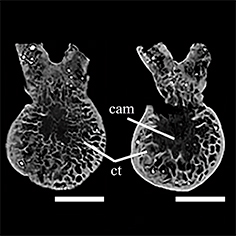
Megaraptora is a clade of tetanuran theropod dinosaurs of uncertain phylogenetic affinity. Members of the constituent family Megaraptoridae are notable for their extreme skeletal pneumaticity. This is exemplified in Murusraptor barrosaensis from the Sierra Barrosa Formation of Patagonia, Argentina. We describe the postcranial pneumaticity of Murusraptor providing naked eye observations and CT scans of internal structures, comparing them with other megaraptorids and other theropod taxa, including birds. Murusraptor, as with other megaraptorids, exhibits pneumaticity patterns that are repeated along the vertebral sequence (e.g., centrum with a central camara surrounded by camellate tissue). However, Murusraptor is unique, given the presence of exposed camellate tissue in the neural spines and two pneumatic foramina in the pubis connected to the iliac peduncle in the ilium. Compared with other related taxa, Murusraptor possesses a pneumaticity pattern intermediate between tyrannosauroids (camellate tissue) and allosauroids (camerae). The exposed camellate tissue in the neural spine may correspond to a "multiple foramina" pattern present only in avian theropods; however, in birds, this feature is found in the neural canal. Further studies of this kind are needed to unravel the paleobiology of this enigmatic group of theropods.
References
Aranciaga Rolando, A.M., Novas, F., & Agnolín, F. (2019). A reanalysis of Murusraptor barrosaensis Coria & Currie (2016) affords new evidence about the phylogenetical relationships of Megaraptora. Cretaceous Research, 99, 104–127.
Aranciaga Rolando M., Garcia Marsá, J.A., & Novas, F.E. (2020). Histology and pneumaticity of Aoniraptor libertatem (Dinosauria, Theropoda), an enigmatic mid-sized megaraptoran from Patagonia. Journal of Anatomy, 237, 741–756 DOI 10.1111/joa.13225.
Aranciaga Rolando M., Méndez, A., Canale, J.I., & Novas, F.E. (2021). Osteology of Aerosteon riocoloradensis (Sereno et al. 2008) a large megaraptoran (Dinosauria: Theropoda) from the Upper Cretaceous of Argentina. Historical Biology, 34, 226–282
DOI 10.1080/08912963.2021.1910816.
Aranciaga Rolando, A.M, Motta, M., Agnolin, F., Manabe, M., Tsuihiji, T., & Novas, F. (2022). A large Megaraptoridae (Theropoda: Coelurosauria) from Upper Cretaceous (Maastrichtian) of Patagonia, Argentina. Scientific Reports, 12, 1–29
Atterholt, J., & Wedel, M. J. (2022). A computed tomography-based survey of paramedullary diverticula in extant Aves. The Anatomical Record, 306, 29–50.
Atterholt, J., Burton, M. G., Wedel, M. J., Benito, J., Fricano, E., & Field, D. J. (2025). Osteological correlates of the respiratory and vascular systems in the neural canals of Mesozoic ornithurines Ichthyornis and Janavis. The Anatomical Record, 1–14. https://doi.org/10.1002/ar.70070
Aureliano, T., Almeida, W., Rasaona, M., & Ghilardi, A. (2024). The evolution of the air sac system in theropod dinosaurs: Evidence from the Upper Cretaceous of Madagascar. Journal of Anatomy, 248 (2), 184–196 DOI: 10.1111/joa.14113
Azuma, Y. & Currie, P. (2000). A new carnosaur (Dinosauria: Theropoda) from the Lower Cretaceous of Japan. Canadian Journal of Earth Sciences, 37, 1735–1753
Benson, R B.J., Carrano, M.T., & Brusatte, S.L. (2010). A new clade of archaic
large-bodied predatory dinosaurs (Theropoda: Allosauroidea) that survived to the
latest Mesozoic. Naturwissenschaften, 97, 71–78.
Benson, R.B., Butler, R.J., Carrano, M.T., & O'Connor, P.M. (2012). Air-filled postcranial
bones in theropod dinosaurs: physiological implications and the ‘reptile’-bird
transition. Biological Reviews, 87 (1), 168–193.
Britt, B.B., 1993. Pneumatic postcranial bones in dinosaurs and other archosaurs.
[PhD thesis. University of Calgary].
Britt, B.B., 1997. Postcranial pneumaticity. In: Currie, P.J., Padian, K. (Eds.), The
Encyclopedia of Dinosaurs. Academic Press, San Diego, pp. 590-593.
Brochu, C.A. (2003). Osteology of Tyrannosaurus Rex: insights from a nearly complete skeleton and high resolution computed tomographic analysis of the skull. Journal of Vertebrate Paleontology, 22 (4), 1–138.
Brum, A.S., Machado, E.B., Almeida Campos, D., & Kellner, A.W.A. (2018). Description of uncommon pneumatic structures of a noasaurid (Theropoda, Dinosauria) cervical vertebra from the Bauru Group (Upper Cretaceous), Brazil. Cretaceous Research, 85, 193–206
Brum, A. S., Machado, E. B., D Almeida Campos, D., & Kellner, A. W. A. (2016). Morphology and internal structure of two new abelisaurid remains (Theropoda, Dinosauria) from the Adamantina Formation (Turonian–Maastrichtian), Bauru Group, Paraná Basin, Brazil. Cretaceous Research, 60, 287–29
Butler, R.J., Barret, M.P., & Gower, D.J. (2009). Postcranial skeletal pneumaticity and air sacs in the earliest pterosaurs. Biology Letters, 5, 557–560.
Cerda, I.A., Salgado, L., & Powell, J.E. (2012). Extreme postcranial pneumaticity in
sauropod dinosaurs from South America. Pal€aontologische Zeitschrift, 86 (4), 441–449.
Coria, R.A., & Currie, P.J. (2016). A new megaraptoran dinosaur (Dinosauria, Theropoda,
Megaraptoridae) from the Late Cretaceous of Patagonia. PLOS ONE 11:e0157973
DOI 10.1371/journal.pone.0157973.
Currie, P.J., & Azuma, Y. (2006). New specimens, including a growth series, of Fukuiraptor (Dinosauria, Theropoda) from the Lower Cretaceous Kitadani Quarry of Japan. Journal of Paleontological Society of Korea, 22(1), 173–193.
Duncker, H. (1971). Structure of avian lungs. Respiration Physiology, 14, 44–63.
Gianechini, F.A., & Zurriaguz, V.L. (2021). Vertebral pneumaticity of the paravian theropod Unenlagia comahuensis, from the Upper Cretaceous of Patagonia. Argentina. Cretaceous Research, 127:104925 DOI 10.1016/j.cretres.2021.104925
Ibiricu, L.M., Lamanna, M.C., Alvarez, Cerda, I., Caglianone, J., Cardozo, N., Luna, C., & Martínez, R. (2025). Latest Cretaceous megaraptorid theropod dinosaur sheds light on megaraptoran evolution and palaeobiology. Nature Communications, 16 https://doi.org/10.1038/s41467-025-63793-5
Janensch, W. (1947). Pneumatizit€at bei Wirbeln von Sauropoden und anderen Saurischiern. Palaeontographica, 7 (I,3), 1–25.
King, A.S. (1966). Structural and functional aspects of the avian lungs and air sacs. International Review of General and Experimental Zoology, 2, 171–267.
Martinelli, A., Borges Ribeiro, L.C., Méndez, A., Macedo Neto, F., Lourencini Cavellani, C., Félix, E., da Fonseca Ferraz, M.L., & de Paula Antunes Texeira, V. (2013). Insight on the theropod fauna from the Uberaba Formation (Bauru Group) Minas Gerais State: New Megaraptoran specimen from Late Cretaceous of Brazil. Rivista Italiana di Paleontologia e Stratigrafia, 119 (2), 205–214.
Motta, M.J., Aranciaga Rolando, A.M., Rozadilla, S., Agnolín, F.E., Chimento, N.R.,
Brisson Egli, F., & Novas, F.E. (2016). New theropod fauna from the Upper Cretaceous
(Huincul Formation) of northwestern Patagonia, Argentina. New Mexico Museum of Natural History and Science Bulletin, 71, 231–253.
Novas, F. E. (1998). Megaraptor namunhuaiquii, gen. et sp. nov., a large-clawed, Late Cretaceous theropod from Patagonia. Journal of Vertebrate Paleontology, 18 (1), 4–9. doi:10.1080/02724634.1998.10011030.
Novas, F.E., Agnolín, F.L., Ezcurra, M.D., Porfiri J., & Canale J.I. (2013). Evolution of the carnivorous dinosaurs during the Cretaceous: the evidence from Patagonia. Cretaceous Research, 45, 174–215.
O'Connor, P.M., & Claessens, L. (2005). Basic avian pulmonary design and flow-through
ventilation in non-avian theropod dinosaurs. Nature, 436, 253–256.
O'Connor, P.M. (2006). Postcranial pneumaticity: an evaluation of soft-tissue influences
on the postcranial skeleton and the reconstruction of pulmonary anatomy in archosaurs. Journal of Morphology, 267, 1199–1226.
Porfiri, J.D., Novas, F., Calvo, J., Agnolín, F., Ezcurra, M., & Cerda, I. (2014). Juvenile specimen of Megaraptor (Dinosauria, Theropoda) sheds light about tyrannosauroid radiation. Cretaceous Research, 51, 35–55.
Porfiri, J.D., Juárez Valieri, R., D. Santos, D., & Lamanna, M. (2018). A new megaraptoran theropod dinosaur from the Upper Cretaceous Bajo de la Carpa Formation of northwestern Patagonia. Cretaceous Research, 89, 302–319.
Romer, A.S., 1956. Osteology of the reptiles. University of Chicago Press, Chicago,
Illinois.
Racicot, R. (2017). Fossil secrets revealed: x-Ray, CT Scanning and applications in paleontology. The Paleontological Society Papers, 22, 21–38.
Romer, A.S., & Parsons, T.S., 1977. The Vertebrate Body, 5th ed. Saunders, Philadelphia
Samathi, A., Chanthasit, P., & Sander, P. (2019). A review of theropod dinosaurs from the Late Jurassic to mid-Cretaceous of Southeast Asia. Annales de Paléontologie, 105 (3), 201–215.
Samathi, A., Sander, P.M., & Chanthasit, P. (2021). A spinosaurid from Thailand (Sao Khua Formation, Early Cretaceous) and a reassessment of Camarillasaurus cirugedae from the Early Cretaceous of Spain. Historical Biology, 33(12), 3480–3494.
Schwarz, D., Frey, E.D., & Meyer, C., (2007)a. Pneumaticity and soft-tissue reconstructions in the neck of diplodocid and dicraeosaurid sauropods. Acta Palaeontologica Polonica, 52 (1), 167–188
Seeley, H.G. (1870). On Ornithopsis, a gigantic animal of the pterodactyle kind from the Wealden. Annals and Magazine of Natural History, 4 (5), 279–283.
Sereno, P.C., Martínez R.N., Wilson, J.A., Varricchio, D.J., Alcober, O., & Larsson, H.C. (2008). Evidence for avian intrathoracic air sacs in a new predatory dinosaur from Argentina. PLOS ONE, 3:e3303 DOI 10.1371/journal.pone.0003303
Watanabe, A., Leone Gold, M.E., Brusatte, S.L., Benson, R.B.J., Choiniere, J., Davidson, A., & Norell, M.A. (2015). Vertebral Pneumaticity in the Ornithomimosaur Archaeornithomimus (Dinosauria: Theropoda) revealed by computed tomography imaging and reappraisal of axial pneumaticity in ornithomimosauria. PLoS One, 10 (12), e0145168. http://dx.doi.org/10.1371/journal.pone.0145168
Wedel, M.J., Cifelli, R.L., & Sanders, R.K. (2000). Sauroposeidon proteles, a new sauropod from the Early Cretaceous of Oklahoma. Journal of Vertebrate Paleontology, 20 (1), 109–114
Wedel, M.J. (2003)a. The evolution of vertebral pneumaticity in sauropod dinosaurs.
Journal of Vertebrate Paleontology, 23 (2), 344-357.
Wedel, M.J. (2003)b. Vertebral pneumaticity, air sacs, and the physiology of sauropod
dinosaurs. Paleobiology, 29 (2), 243–255.
Wedel, M.J., 2005. Postcranial skeletal pneumaticity in sauropods and its implications
for mass estimates. In: Wilson, J.A., Curry-Rogers, K. (Eds.), The Sauropods:
Evolution and Paleobiology. University of California Press, Berkeley, pp. 201e228.
Wedel, M.J. (2006). Origin of postcranial skeletal pneumaticity in dinosaurs. Integrative Zoology, 2, 80–85.
Wedel, M. (2007). What pneumaticity tells us about “prosauropods” and vice versa. Special Papers in Palaeontology, 77, 207-222.
Wedel, M.J. (2009). Evidence for bird-like air sacs in saurischian dinosaurs. Journal of
Experimental Zoology, 311A. http://dx.doi.org/10.1002/jez.513.
Wilson, J.A. (1999). A nomenclature for vertebral laminae in sauropods and other saurischians dinosaurs. Journal of Vertebrate Paleontology, 19 (4), 639–653.
Wilson, J.A., D'Emic, M.D., Ikejiri, T., Moacdieh, E.M., & Whitlock, J.A. (2011). A nomenclature for vertebral fossae in sauropods and other saurischian dinosaurs. PLoS One 6 (2): e17114. http://dx.doi.org/10.1371/journal.pone.0017114.
Windholz, G.J., Meso, J.G., Wedel, M.J., & Pittman, M. (2025) First unambiguous record of pneumaticity in the axial skeleton of alvarezsaurians (Theropoda: Coelurosauria). PLoS ONE, 20(4): e0320121.https://d
Additional Files
Published
Issue
Section
License
Copyright (c) 2026 Virginia Laura Zurriaguz, Mattia Antonio Baiano, Rodolfo Aníbal Coria

This work is licensed under a Creative Commons Attribution-NoDerivatives 4.0 International License.

Authors retain copyright and grant the journal right of first publication with the work simultaneously licensed under a Atribución/Reconocimiento 4.0 Internacional that allows others to share the work with an acknowledgement of the work's authorship and initial publication in this journal.

 0.299 Q3 | H Index 12
 CiteScore 2.2