NEW APPROACHES IN PALYNOLOGICAL PROCESSING: TACKLING CALCIUM FLUORIDE FORMATION
Nuevas perspectivas en el procesamiento palinológico: abordando la formación de fluoruro de calcio
DOI:
https://doi.org/10.5710/PEAPA.13.08.2026.584Keywords:
Palynology, Processing techniques, Calcium fluorideAbstract
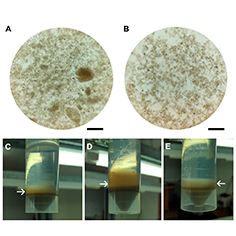
Palynological processing comprises both traditional and non-traditional protocols, designed to recover representative assemblages of the depositional environments. In this context, the quality of palynological preparations is critical to ensure reliable and representative results. In this study, three different methodologies were implemented, each involving modifications to conventional palynological protocols, with the aim of removing or preventing the formation of insoluble calcium fluoride colloids generated following hydrofluoric acid treatment. The first treatment consisted of removing the already formed gel by the process of the organic residue with hydrochloric acid followed by washes with a sodium pyrophosphate solution. The second treatment included a deflocculation step using sodium pyrophosphate prior to the initial hydrofluoric treatment, modified from previously proposed protocols, in order to prevent colloid formation. The third treatment involved increasing the number of neutralization washes between acid treatments, also adapted from published palynological protocols, performing the final hydrochloric acid treatment in a heated water-bath. The results indicate that the most effective approach was to allow the formation of insoluble colloids and subsequently treat the residue with hydrochloric acid in heated water baths. In contrast, the intermediate deflocculation step, commonly recommended for such cases, proved unsuitable due to the scarce recovery of organic residue and the formation of colloids.
References
Bates, C.D., Coxon, P., & Gibbard, P.L. (1978). A new method for the preparation of clay-rich sediment samples for palynological analysis. New Phytologist, 81 (2), 459– 463. https://doi.org/10.1111/j.1469-8137.1978.tb02651.x
Batten, D.J. (1999). Small palynomorphs. In: Jones T.P, & Rowe N.P (Eds), Fossil plants and spores: modern techniques. (1° ed, pp. 15-19). Geological Society of London.
Faegri, K., & Iversen, J. (1989). Textbook of Pollen Analysis. (4° ed). John Wiley & Sons.
Heusser, L.E., & Stock, C.E. (1984). Preparation techniques for concentrating pollen from marine sediments and other sediments with low pollen density. Palynology 8 (1), 225–227. https://doi.org/10.1080/01916122.1984.9989279
Hyde, H.A, & Williams, D.A. (1944). The right word. Pollen Analysis Circular 8, 6.
Louwye, S., Head, M.J., & De Schepper, S. (2004). Palaeoenvironment and dinoflagellate cyst stratigraphy of the Pliocene in northern Belgium at the southern margin of the North Sea Geological Magazine 141 (3), 353- 378. https://doi.org/10.1017/S0016756804009136
Matsuoka, K., & Fukuyo, Y. (2000). Technical guide for modern dinoflagellate cyst study. WESTPAC-HAB/WESTPAC/IOC 2000.
Moss, P.T. (2013). Palynology and its application to geomorphology. In: Shroder, J. (Editor in Chief), Switzer, A.D., Kennedy, D.M. (Eds.), Treatise on Geomorphology. Academic Press, San Diego, CA, vol. 14, Methods in Geomorphology, pp. 315–325. http://dx.doi.org/10.1016/B978-0-12-374739-6.00395-X
Moss, P.T., Greenwood, D.R., & Archibald, S.B. (2005). Regional and local vegetation community dynamics of the Eocene Okanagan Highlands (British Columbia– Washington State) from palynology1. Canadian Journal of Earth Sciences 42, 187- 204. https://doi.org/10.1139/e04-095
Moss, P.T., Smith, R.Y., & Greenwood, D.R. (2016). A window into mid-latitudinal Early Eocene environmental variability: a high-resolution palynological analysis of the Falkland site, Okanagan Highlands, British Columbia, Canada1. Canadian Journal of Earth Sciences 53, 605– 613. dx.doi.org/10.1139/cjes-2015-0167
Noetinger, S., Pujana, R.R., Burrieza, A., & Burrieza, H. P. (2017). Use of UV-curable acrylates gels as mounting media for palynological samples. Revista del Museo Argentino de Ciencias Naturales 19 (1), 19–23. https://dx.doi.org/10.22179/REVMACN.19.482
O’Keefe, J.M.K., & Eble, C.F. (2012). A comparison of HF-based and non-HF based palynology processing techniques in clay-rich lignites from the Claiborne Group. Palynology 36 (1), 116–130. http://dx.doi.org/10.1080/01916122.2011.642484
Pound, M.J., O’Keefe, J.M.K., & Marret, F. (2021). An overview of techniques applied to the extraction of non-pollen palynomorphs, their known taphonomic issues and recommendations to maximize recovery. Geological Society, London, Special Publications 511, 63- 76 https://doi.org/10.1144/SP511-2020-40
Riding, J.B., & Kyffin-Hughes, J.E. (2004). A review of the laboratory preparation of palynomorphs with a description of an effective non-acid technique. Revista Brasileira de Paleontologia 7 (1), 13–44. https://doi.org/10.4072/rbp.2004.1.02
Riding, J.B., & Kyffin-Hughes, J.E. (2006). Further testing of a non-acid palynological preparation procedure. Palynology 30 (1), 69–87. https://doi.org/10.2113/gspalynol.30.1.69
Riding, J.B., & Kyffin-Hughes, J.E. (2010). The use of pre-treatments in palynological processing. Review of Palaeobotany and Palynology 158 (3–4), 281–290. https://doi.org/10.1016/J.REVPALBO.2009.09.009
Riding, J.B. (2021). A guide to preparation protocols in palynology. Palynology 45 (1), 1-110 https://doi.org/10.1080/01916122.2021.1878305
Stockmarr, J. (1971). Tablets with spores used in absolute pollen analysis. Pollen et Spores 13, 615-621.
Traverse, A. (2007). Paleopalynology. (2° ed). Amsterdam Springer.
Traverse, A. (1994). Sedimentation of organic particles. Cambridge University Press.
Tyson, R.V. (1995). Sedimentary organic matter. Organic facies and palynofacies. Chapman and Hall, London.
Additional Files
Published
Issue
Section
License
Copyright (c) 2026 Mariana Evelyn Raab, Pablo Esteban Diaz, Maria Soledad Candel, Isabel Vilanova

This work is licensed under a Creative Commons Attribution-NoDerivatives 4.0 International License.
Authors retain copyright and grant the journal right of first publication with the work simultaneously licensed under a Atribución/Reconocimiento 4.0 Internacional that allows others to share the work with an acknowledgement of the work's authorship and initial publication in this journal.

 0.299 Q3 | H Index 12
 CiteScore 2.2