HEAD, SKULL–NECK AND EXTRINSIC EYE MUSCULATURE OF THE DICRAEOSAURID SAUROPOD BAJADASAURUS PRONUSPINAX
Musculatura de la cabeza, cabeza-cuello y ocular extrínseca del saurópodo dicraeosáurido Bajadasaurus pronuspinax
DOI:
https://doi.org/10.5710/PEAPA.11.11.2025.553Keywords:
Bajadasaurus, Dicraeosauridae, Sauropoda, Cranial musculature, PaleoecologyAbstract
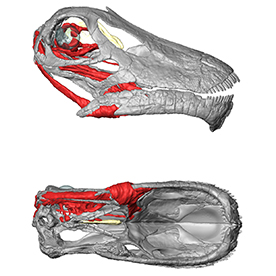
Cranial muscles perform important roles triggering diverse paleobiological faculties, such as feeding, communication, alert postures, etc. Within Sauropoda, a clade with high specializations in skull architectures, and several partially complete skulls recovered, detailed reconstructions of the cranial muscles are mainly limited to two of the most famous taxa of the clade: Diplodocus and Camarasaurus. The cranial musculature for Dicraeosauridae, a minor group within the clade, has been gingerly described, based on the few suitable specimens. Herein, the craniomandibular, extrinsic eye, and cervicocranial musculatures of Bajadasaurus pronuspinax are inferred, resulting in the first detailed reconstruction for Dicraeosauridae on these muscular groups, and these are compared with previous inferences in Dicraeosauridae and with other Sauropoda and non-avian dinosaurs. The musculature of Bajadasaurus shows a shift of angle in the temporal musculature when passing through the inferior temporal window (probably indicating the presence of a cartilage for support), an important role of the orbitotemporal muscles in a hypothetical cranial kinesis (which, if true, would allow pseudo-palinal movements in a rostral directionduring the feeding process), an avian-like configuration of the eye muscles, and high lateroflexor moment arms for the skull-neck complex. Dicraeosauridae show clear osteological correlates for a high number of the craniomandibular and cervicocranial muscles, albeit some of these correlates might not be exclusively dedicated for musculature, and could be indicating the presence of alternative soft tissues.
References
Al-Hassawi, A. M. (2007). A comparative anatomy of the neck region in lizards: a research study. Trafford Publishing.
Barrett, P. M., & Upchurch, P. (1994). Feeding mechanisms of Diplodocus. Gaia, 10, 195–203.
Bona, P., & Desojo, J. B. (2011). Osteology and cranial musculature of Caiman latirostris (Crocodylia: Alligatoridae). Journal of Morphology, 272(7), 780–795. https://doi.org/10.1002/jmor.10894
Button, D. J., Rayfield, E. J., & Barrett, P. M. (2014). Cranial biomechanics underpins high sauropod diversity in resource-poor environments. Proceedings of the Royal Society B: Biological Sciences, 281(1795), 20142114. https://doi.org/10.1098/rspb.2014.2114
Button, D. J., Barrett, P. M., & Rayfield, E. J. (2016). Comparative cranial myology and biomechanics of Plateosaurus and Camarasaurus and evolution of the sauropod feeding apparatus. Palaeontology, 59(6), 887–913. https://doi.org/10.1111/pala.12266
Calvo, J. O. (1994). Jaw mechanics in sauropod dinosaurs. Gaia, 10, 183–193.
Daza, J. D., Diogo, R., Johnston, & P., Abdala, V. (2011). Jaw adductor muscles across lepidosaurs: a reappraisal. The Anatomical Record, 294(10), 1765–1782. https://doi.org/10.1002/ar.21467
Franz‐Odendaal, T. A. (2018). Skeletons of the eye: An evolutionary and developmental perspective. The Anatomical Record, 303(1), 100–109. https://doi.org/10.1002/ar.24043
Gallina, P. A., Apesteguía, S., Canale, J. I., & Haluza, A. (2019). A new long-spined dinosaur from Patagonia sheds light on sauropod defense system. Scientific reports, 9(1), 1–10. https://doi.org/10.1038/s41598-018-37943-3
Garderes, (2024). Anatomía y biomecánica craniodental de Bajadasaurus pronuspinax (Dinosauria, Sauropoda) y sus implicancias en el comportamiento alimentario de los diplodocoideos. [Doctoral thesis]. Facultad de Ciencias Naturales y Museo, Universidad Nacional de La Plata, Argentina. https://doi.org/10.35537/10915/167625
Garderes, J. P., Militello, M., Whitlock, J. A., Toledo, N., & Gallina, P. A. (2022). Retro- acupuncture: craniocervical musculature of the dicraeosaurid sauropod dinosaur Bajadasaurus pronuspinax. 82nd Annual Meeting of the Society of Vertebrate Paleontology, Programs and Abstracts (p. 154). Toronto.
Garderes, J. P., Gallina, P. A., Whitlock, J. A., & Toledo, N. (2023). Cranial osteology of Bajadasaurus pronuspinax (Sauropoda, Dicraeosauridae). Historical Biology, 36(7), 1– 25. https://doi.org/10.1080/08912963.2023.2212389
Gorniak, G. C., Rosenberg, H. I., & Gans, C. (1982). Mastication in the tuatara, Sphenodon punctatus (Reptilia: Rhynchocephalia): structure and activity of the motor system. Journal of Morphology, 171(3), 321–353. https://doi.org/10.1002/jmor.1051710307
Gröning, F., Jones, M. E., Curtis, N., Herrel, A., O'Higgins, P., Evans, S. E., & Fagan, M. J. (2013). The importance of accurate muscle modelling for biomechanical analyses: a case study with a lizard skull. Journal of the Royal Society Interface, 10(84), 20130216. https://doi.org/10.1098/rsif.2013.0216
Haas, G. (1963). A proposed reconstruction of the jaw musculature of Diplodocus. Annals of the Carnegie Museum 36, 139–157.
Harris, J. D. (2006). Cranial osteology of Suuwassea emilieae (Sauropoda: Diplodocoidea: Flagellicaudata) from the Upper Jurassic Morrison Formation of Montana, USA. Journal of Vertebrate Paleontology, 26, 88–102. https://doi.org/10.1671/0272-4634(2006)26[88:COOSES]2.0.CO;2
Harris, J. D., & Dodson, P. (2004). A new diplodocoid sauropod dinosaur from the Upper Jurassic Morrison Formation of Montana, USA. Acta Palaeontologica Polonica 49,197–210.
Hieronymus, T. L. (2009). Osteological correlates of cephalic skin structures in Amniota: documenting the evolution of display and feeding structures with fossil data. [Doctoral thesis]. Ohio University, United States of America. http://rave.ohiolink.edu/etdc/view?acc_num=ohiou1237491191
Holliday, C. M. (2009). New insights into dinosaur jaw muscle anatomy. The Anatomical Record: Advances in Integrative Anatomy and Evolutionary Biology: Advances in Integrative Anatomy and Evolutionary Biology, 292(9), 1246–1265. https://doi.org/10.1002/ar.20982
Holliday, C. M., & Witmer, L. M. (2007). Archosaur adductor chamber evolution: integration of musculoskeletal and topological criteria in jaw muscle homology. Journal of Morphology, 268(6), 457–484. https://doi.org/10.1002/jmor.10524
Holliday, C. M., & Witmer, L. M. (2008). Cranial kinesis in dinosaurs: intracranial joints, protractor muscles, and their significance for cranial evolution and function in diapsids. Journal of Vertebrate Paleontology, 28(4), 1073–1088. https://doi.org/10.1671/0272-4634-28.4.1073
Holliday, C. M., Porter, W. R., Vliet, K. A., & Witmer, L. M. (2019). The frontoparietal fossa and dorsotemporal fenestra of archosaurs and their significance for interpretations of vascular and muscular anatomy in dinosaurs. The Anatomical Record, 303(4), 1060–1074. https://doi.org/10.1002/ar.24218
Janensch, W. (1935-36). Die Schädel der Sauropoden Brachiosaurus, Barosaurus und Dicraeosaurus aus den Tendaguruschichten Deutsch-Ostafrikas (Anfang). Palaeontographica-Supplementbände, 145–248.
Jones, M. E., Curtis, N., O'Higgins, P., Fagan, M., & Evans, S. E. (2009). The head and neck muscles associated with feeding in Sphenodon (Reptilia: Lepidosauria: Rhynchocephalia). Palaeontologia Electronica, 12(2).
Lautenschlager, S. (2013). Cranial myology and bite force performance of Erlikosaurus andrewsi: a novel approach for digital muscle reconstructions. Journal of Anatomy, 222(2), 260–272. https://doi.org/10.1111/joa.12000
Lautenschlager, S., Bright, J. A., & Rayfield, E. J. (2013). Digital dissection–using contrast‐enhanced computed tomography scanning to elucidate hard‐and soft‐ tissue anatomy in the Common Buzzard Buteo buteo. Journal of Anatomy, 224(4), 412–431. https://doi.org/10.1111/joa.12153
Lautenschlager, S., Witmer, L. M., Altangerel, P., Zanno, L. E., & Rayfield, E. J. (2014). Cranial anatomy of Erlikosaurus andrewsi (Dinosauria, Therizinosauria): new insights based on digital reconstruction. Journal of Vertebrate Paleontology, 34(6), 1263–1291. https://doi.org/10.1080/02724634.2014.874529
Lautenschlager, S., Brassey, C. A., Button, D. J., & Barrett, P. M. (2016). Decoupled form and function in disparate herbivorous dinosaur clades. Scientific Reports, 6(1), 26495. https://doi.org/10.1038/srep26495
Lessner, E. J., & Holliday, C. M. (2020). A 3D ontogenetic atlas of Alligator mississippiensis cranial nerves and their significance for comparative neurology of reptiles. The Anatomical Record, 305(10), 2854–2882. https://doi.org/10.1002/ar.24550
Martínez, R. D., Lamanna, M. C., Novas, F. E., Ridgely, R. C., Casal, G. A., Martínez, J. E., Vita, J. R., & Witmer, L. M. (2016). A basal lithostrotian titanosaur (Dinosauria: Sauropoda) with a complete skull: implications for the evolution and paleobiology of Titanosauria. PloS one, 11(4), e0151661. https://doi.org/10.1371/journal.pone.0151661
Martini, P., Schmid, P., & Costeur, L. (2017). Comparative morphometry of bactrian camel and dromedary. Journal of Mammalian Evolution, 25(3), 407–425. https://doi.org/10.1007/s10914-017-9386-9
Militello, M. Estudio anatómico y paleohistológico de la región cervical en Sauropoda (Dinosauria, Saurischia): implicancias paleobiológicas y evolutivas. [Doctoral thesis in preparation]. Facultad de Ciencias Naturales y Museo, Universidad Nacional de La Plata. [Eng. Anatomical and paleohistological study of the cervical region in Sauropoda (Dinosauria, Saurischia): paleobiological and evolutive implications.]
Nabavizadeh, A. (2020). Cranial musculature in herbivorous dinosaurs: a survey of reconstructed anatomical diversity and feeding mechanisms. The Anatomical Record, 303(4), 1104–1145. https://doi.org/10.1002/ar.24283
Nagesan, R. (2017). Neck Mobility of the Plesiosaur Nichollsaura borealis. [Doctoral thesis]. University of Calgary, Canada. http://hdl.handle.net/11023/4042
Paulina-Carabajal, A., Carballido, J. L., & Currie, P. J. (2014). Braincase, neuroanatomy, and neck posture of Amargasaurus cazaui (Sauropoda, Dicraeosauridae) and its implications for understanding head posture in sauropods. Journal of Vertebrate Paleontology, 34(4), 870–882. https://doi.org/10.1080/02724634.2014.838174
Peters, J., & Von Den Driesch, A. (1997). The two‐humped camel (Camelus bactrianus): New light on its distribution, management and medical treatment in the past. Journal of Zoology, 242(4), 651–679. https://doi.org/10.1111/j.1469- 7998.1997.tb05819.x
Rybczynski, N., Tirabasso, A., Bloskie, P., Cuthbertson, R., & Holliday, C. (2008). A three-dimensional animation model of Edmontosaurus (Hadrosauridae) for testing chewing hypotheses. Palaeontologia Electronica, 11(2), 1–14.
Salgado, L., & Calvo, J. O. (1992). Cranial osteology of Amargasaurus cazaui Salgado & Bonaparte (Sauropoda, Dicraeosauridae) from the Neocomian of Patagonia. Ameghiniana, 29(4), 337–346.
Schumacher, G. H. (1973). The head muscles and hyolaringeal skeleton of turtles and crocodilians. In: Biology of the reptilia, vol. 4. (pp. 101– 200). Academic Press.
Sereno, P. C., Beck, A. L., Dutheil, D. B., Larsson, H. C., Lyon, G. H., Moussa, B., Sadlier, R. W., Sidor, C. A., Varricchio, D. J., Wilson, G. P., & Wilson, J. A. (1999). Cretaceous sauropods from the Sahara and the uneven rate of skeletal evolution among dinosaurs. Science, 286, 1342–1347. https://doi.org/10.1371/journal.pone.0001230
Sharpe, H. S., Wang, Y. Y., Dudgeon, T. W., Powers, M. J., Whitebone, S. A., Coppock, C. C., Dyer, A. D., & Sullivan, C. (2025). Skull morphology and histology indicate the presence of an unexpected buccal soft tissue structure in dinosaurs. Journal of Anatomy. https://doi.org/10.1111/joa.14242
Smith, D. K. (2015). Craniocervical myology and functional morphology of the small- headed therizinosaurian theropods Falcarius utahensis and Nothronychus mckinleyi. Plos one, 10(2), e0117281. https://doi.org/10.1371/journal.pone.0117281
Smith-Paredes, D., & Bhullar, B. A. S. (2019). The skull and head muscles of archosauria. In Heads, jaws, and muscles: anatomical, functional, and developmental diversity in chordate evolution (pp. 229–251). Springer. https://doi.org/10.1007/978-3-319-93560-7_10
Snively, E., & Russell, A. P. (2007a). Functional variation of neck muscles and their relation to feeding style in Tyrannosauridae and other large theropod dinosaurs. The Anatomical Record: Advances in Integrative Anatomy and Evolutionary Biology: Advances in Integrative Anatomy and Evolutionary Biology, 290(8), 934–957. https://doi.org/10.1002/ar.20563
Snively, E., & Russell, A. P. (2007b). Functional morphology of neck musculature in the Tyrannosauridae (Dinosauria, Theropoda) as determined via a hierarchical inferential approach. Zoological Journal of the Linnean Society, 151(4), 759–808. https://doi.org/10.1111/j.1096-3642.2007.00334.x
Snively, E., & Russell, A. P. (2007c). Craniocervical feeding dynamics of Tyrannosaurus rex. Paleobiology, 33(4), 610–638. https://doi.org/10.1666/06059.1
Snively, E., Russell, A. P., Powell, G. L., Theodor, J. M., & Ryan, M. J. (2013a). The role of the neck in the feeding behaviour of the Tyrannosauridae: inference based on kinematics and muscle function of extant avians. Journal of Zoology, 292(4), 290– 303. https://doi.org/10.1111/jzo.12109
Snively, E., Cotton, J. R., Ridgely, R., & Witmer, L. M. (2013b). Multibody dynamics model of head and neck function in Allosaurus (Dinosauria, Theropoda). Palaeontologia Electronica, 16(2), 1–29. https://doi.org/10.26879/338
Taylor, A. C., Lautenschlager, S., Qi, Z., & Rayfield, E. J. (2017). Biomechanical evaluation of different musculoskeletal arrangements in Psittacosaurus and implications for cranial function. The Anatomical Record, 300(1), 49–61. https://doi.org/10.1002/ar.23489
Tschopp, E., & Mateus, O. (2013). The skull and neck of a new flagellicaudatan sauropod from the Morrison Formation and its implication for the evolution and ontogeny of diplodocid dinosaurs. Journal of Systematic Palaeontology, 11(7), 853–888. https://doi.org/10.1080/14772019.2012.746589
Tschopp, E., Mateus, O., & Benson, R. B. J. (2015). A specimen-level phylogenetic analysis and taxonomic revision of Diplodocidae (Dinosauria, Sauropoda). PeerJ, 3, e857. https://doi.org/10.7717/peerj.857
Tschopp, E., Mateus, O., & Marzola, M., Norell, M. (2018). Indications for a horny beak and extensive supraorbital connective tissue in diplodocid sauropods. Annual Meeting of the Society of Vertebrate Paleontology (p. 229). Society of Vertebrate Paleontology. Albuquerque.
Tsuihiji, T. (2007). Homologies of the longissimus, iliocostalis, and hypaxial muscles in the anterior presacral region of extant Diapsida. Journal of Morphology, 268(11), 986–1020. https://doi.org/10.1002/jmor.10565
Tsuihiji, T. (2010). Reconstructions of the axial muscle insertions in the occipital region of dinosaurs: evaluations of past hypotheses on Marginocephalia and Tyrannosauridae using the Extant Phylogenetic Bracket approach. The Anatomical Record: Advances in Integrative Anatomy and Evolutionary Biology, 293(8), 1360–1386. https://doi.org/10.1002/ar.21191
Upchurch, P., & Barrett, P. M. (2000). The evolution of sauropod feeding mechanisms. In: Sues HD, editor. Evolution of Herbivory in Terrestrial Vertebrates: Perspectives from the Fossil Record (pp. 79–122). Cambridge University Press.
Van den Berge, C., & Zweers, G. A. (1993). Myologia. In: Handbook of avian anatomy: nomina anatomica avium (pp. 189–247). Nuttall Ornithological Club.
Wedin, B. 1953. The origin and development of the extrinsic ocular muscles in the alligator. Journal of Morphology, 92(2), 303–335.
Whitlock, J. A. (2011). Inferences of diplodocoid (Sauropoda: Dinosauria) feeding behavior from snout shape and microwear analyses. PLoS One, 6(4), e18304. https://doi.org/10.1371/journal.pone.0018304
Whitlock, J. A. (2017). Was Diplodocus (Diplodocoidea, Sauropoda) capable of propalinal jaw motion?. Journal of Vertebrate Paleontology, 37(2), e1296457. https://doi.org/10.1080/02724634.2017.1296457
Whitlock, J. A., & Wilson Mantilla, J. A. (2020). The Late Jurassic sauropod dinosaur ‘Morosaurus’ agilis Marsh, 1889 reexamined and reinterpreted as a dicraeosaurid. Journal of Vertebrate Paleontology 40(6), e1780600 . https://doi.org/10.1080/ 02724634.2020.1780600.
Witmer, L. M. (1995). The extant phylogenetic bracket and the importance of reconstructing soft tissues in fossils. Functional morphology in vertebrate paleontology, 1, 19–33.
Witzmann, F., Brainerd, E. L., & Konow, N. (2019). Eye movements in frogs and salamanders—testing the palatal buccal pump hypothesis. Integrative Organismal Biology, 1(1), obz011. https://doi.org/10.1093/iob/obz011
Xu, X., Upchurch, P., Mannion, P. D., Barrett, P. M., Regalado-Fernandez, O. R., Mo, J., Ma, J., & Liu, H. (2018). A new Middle Jurassic diplodocoid suggests an earlier dispersal and diversification of sauropod dinosaurs. Nature communications, 9(1), 1–9. https://doi.org/10.1038/s41467-018-05128-1
Young, M. T., Rayfield, E. J., Holliday, C. M., Witmer, L. M., Button, D. J., Upchurch, P., & Barrett, P. M. (2012). Cranial biomechanics of Diplodocus (Dinosauria, Sauropoda): testing hypotheses of feeding behaviour in an extinct megaherbivore. Naturwissenschaften, 99(8), 637–643. https://doi.org/10.1007/s00114-012-0944-y
Zheng, Z. (1996). Cranial anatomy of Shunosaurus and Camarasaurus (Dinosauria: Sauropoda) and the phylogeny of the Sauropoda. [Doctoral thesis]. Texas Tech University.
Additional Files
Published
Issue
Section
License
Copyright (c) 2026 Juan Pablo Garderes, Néstor Toledo, John Andrew Whitlock, Mariano Militello, Pablo Ariel Gallina

This work is licensed under a Creative Commons Attribution-NoDerivatives 4.0 International License.
Authors retain copyright and grant the journal right of first publication with the work simultaneously licensed under a Atribución/Reconocimiento 4.0 Internacional that allows others to share the work with an acknowledgement of the work's authorship and initial publication in this journal.

 0.299 Q3 | H Index 12
 CiteScore 2.2