HOP ON THE GAME: IDENTIFICATION KEYS TO MEDIUM- TO LARGE-SIZED ANURANS OF ARGENTINA USING JUST ONE BONE
Unite al juego: Claves para identificar anuros de mediano y gran tamaño de Argentina con apenas un hueso
DOI:
https://doi.org/10.5710/PEAPA.22.07.2026.572Keywords:
Amphibia, Anura, Dichotomous key, Fossils, Frogs, Osteology, Paleontology, ZooarcheologyAbstract
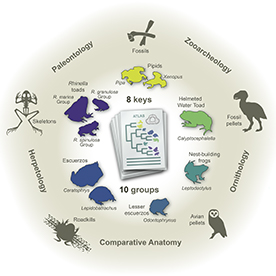
Anurans (frogs, toads, escuerzos) have been an important part of terrestrial ecosystems since the Mesozoic era. Their bones, although relatively fragile, are frequently found as fossils, as well as in pellets, and carry useful taxonomic and ecological data, which in turn have the potential to inform about environmental and climatic conditions. However, these remains are often unidentified as such or, at best, identified as indeterminate anurans, thereby downplaying the value of isolated anuran bones. This situation has been fueled by the scarcity of specialists, but also by the lack of appropriate osteological collections and specialized literature that could provide tools for their study. With the aim of alleviating these shortcomings and hoping to spark interest in the study of amphibian osteology, we provide eight dichotomous keys (both in English and Spanish) for identifying isolated bones of medium- to large-sized anurans from Argentina, which make up most of its amphibian fossil record. In all cases, dichotomous keys allow for the successful identification of families and, in most cases, genera. A case study highlights the effectiveness of these keys in identifying a fossil Rhinella toad originally cataloged as Ceratophrys. We expect our dichotomous keys to be a useful tool for anyone dealing with the postcranial skeletal morphology of Neotropical anurans, including paleontologists, archaeologists, herpetologists, ornithologists, museum staff, and the general public.
References
Alcaráz, A. P., & Kaufmann, C. A. (2022). Patrón de consumo de anuros por Athene cunicularia: Implicancias para el registro arqueológico de la región Pampeana. Comechingonia, 26, 41–50.
AmphibiaWeb. (2026). University of California (Ed.), AmphibiaWeb. Accessed on March 23 2026 from http://amphibiaweb.org
Báez, A. M., & Gómez, R. O. (2018). Dealing with homoplasy: osteology and phylogenetic relationships of the bizarre neobatrachian frog Baurubatrachus pricei from the Upper Cretaceous of Brazil. Journal of Systematic Palaeontology, 16, 279–308.
Báez, A. M., Gómez, R. O., & Taglioretti, M. L. (2012). The archaic ilial morphology of an enigmatic pipid frog from the upper Pleistocene of the South American pampas. Journal of Vertebrate Paleontology, 32, 304–314.
Báez, A. M., Moura, G. J., & Gómez, R. O. (2009). Anurans from the Lower Cretaceous Crato Formation of northeastern Brazil: implications for the early divergence of neobatrachians. Cretaceous Research, 30, 829–846.
Báez, A. M., & Pugener, L. A. (2003). Ontogeny of a new Palaeogene pipid frog from southern South America and xenopodinomorph evolution. Zoological Journal of the Linnean Society, 139, 439–476.
Bailon, S. (1999). Différenciation ostéologique des anoures (Amphibia, Anura) de France. Fiches d'ostéologie animale pour l'archéologie. Série C. Varia, 1, 3–38.
Barcelos, L. A., & dos Santos, R. O. (2023). The Lissamphibian Fossil Record of South America: Fossil Record of South American Lissamphibians. Palaeobiodiversity and Palaeoenvironments, 103, 341–405.
Bastir, M., Böhme, M., & Sanchiz, B. (2014). Middle Miocene remains of Alytes (Anura, Alytidae) as an example of the unrecognized value of fossil fragments for evolutionary morphology studies. Journal of Vertebrate Paleontology, 34, 69–79.
Bisbal-Chinesta, J. F., Banuls-Cardona, S., Fernandez-Garcia, M., Cáceres, I., Blain, H. A., & Vergès, J. M. (2020). Elucidating anuran accumulations: massive taphocenosis of tree frog Hyla from the Chalcolithic of El Mirador cave (Sierra de Atapuerca, Spain). Journal of Archaeological Science: Reports, 30, 102277.
Blackburn, D. C., Boyer, D. M., Gray, J. A., Winchester, J., Bates, J. M., Baumgart, S. L., Braker, E., Coldren, D., Conway, K. W., Rabosky, A. D., de la Sancha, N., Dillman, C. B., Dunnum, J. L., Early, C. M., Frable, B. W., Gage, M. W., Hanken, J., Maisano, J. A., Marks, B. D., … & Stanley, E. L. (2024). Increasing the impact of vertebrate scientific collections through 3D imaging: The openVertebrate (oVert) thematic collections network. BioScience, 74, 169–186.
Blackburn, D. C., Keeffe, R. M., Vallejo-Pareja, M. C., & Vélez-Juarbe, J. (2020). The earliest record of Caribbean frogs: a fossil coquí from Puerto Rico. Biology letters, 16, 20190947.
Blain, H. A., Bailon, S., Cuenca-Bescós, G., Arsuaga, J. L., de Castro, J. M. B., & Carbonell, E. (2009). Long-term climate record inferred from early-middle Pleistocene amphibian and squamate reptile assemblages at the Gran Dolina Cave, Atapuerca, Spain. Journal of Human Evolution, 56, 55–65.
Blain, H. A., Martínez Monzón, A., Bisbal-Chinesta, J. F., López-García, J. M., Cousin, C., & Folie, A. (2022). The last interglacial-glacial cycle in the Meuse Valley (southern Belgium) inferred from the amphibian and reptile assemblages: implications for Neanderthals and anatomically modern humans. Archaeological and Anthropological Sciences, 14, 5.
Blain, H. A., Santonja, M., Pérez-González, A., Panera, J., & Rubio-Jara, S. (2014). Climate and environments during Marine Isotope Stage 11 in the central Iberian Peninsula: the herpetofaunal assemblage from the Acheulean site of Áridos-1, Madrid. Quaternary Science Reviews, 94, 7–21.
Bolaños, F., Castro, F., De la Riva, I., Grant, T., Hedges, B., Heyer, W. R., Ibáñez, R. D., La Marca, E., Lavilla, E., Leite Silvano, D., Lötters, S., Parra Olea, G., Reichle, S., Reynolds, R. P., Rodríguez, L., Santos Barrera, G., Scott, N., Ubeda, C., Veloso, A., Wilkinson, M., & Young, B. (2008). Amphibians of the Neotropical Realm. In S. N. Stuart, M. Hoffmann, J. S. Chanson, N. A. Cox, R. J. Berridge, P. Ramani, & B. E. Young (Eds.), Threatened Amphibians of the World (pp. 92–105). Lynx Editions.
Brandoni, D., Schmidt, G. I., Bona, P., Tarquini, J., Vlachos, E., & Noriega, J. I. (2025). New vertebrates from the Ituzaingó Formation (Late Miocene of Entre Ríos Province, Argentina), including first records of Leptodactylus (Amphibia, Anura) and Chelonoidis (Testudines, Cryptodira). Historical Biology, 37, 1417–1428.
Buser, T. J., Boyd, O. F., Cortés, Á., Donatelli, C. M., Kolmann, M. A., Luparell, J. L., Pfeiffenberger, J. A., Sidlauskas, B. L., & Summers, A. P. (2020). The natural historian's guide to the CT galaxy: step-by-step instructions for preparing and analyzing computed tomographic (CT) data using cross-platform, open access software. Integrative Organismal Biology, 2, obaa009.
Ceron, K., Sales, L. P., Santana, D. J., & Pires, M. M. (2023). Decoupled responses of biodiversity facets driven from anuran vulnerability to climate and land‐use changes. Ecology Letters, 26, 869–882.
Cignoni, P., Callieri, M., Corsini, M., Dellepiane, M., Ganovelli, F., & Ranzuglia, G. (2008). MeshLab: an Open-Source Mesh Processing Tool. Sixth Eurographics Italian Chapter Conference. Eurographics Italian Chapter Proceedings (pp. 129–136). Salerno.
Cione, A. L., & Báez, A. M. (2007). Peces continentales y anfibios cenozoicos de Argentina los últimos cincuenta años. Asociación Paleontológica Argentina. Publicación Especial, 11, 195–220.
Cruz, J. A., Basanta, M. D., García-Castillo, M. G., Wooldrich-Piña, G. A., & Parra-Olea, G. (2024). Amphibians environmental dependence and their use in Paleoecological reconstructions. In Past Environments of Mexico: Unveiling the Past Environments of a Megadiverse Country Through its Fossil Record (pp. 253–271). Cham: Springer Nature.
Cruz, L. E., Fernicola, J. C., & Carignano, C. A. (2018). New vertebrates of the Brochero Formation (Córdoba, Argentina): a review of the Pliocene of central Argentina. Journal of Mammalian Evolution, 25, 315–326.
de Albuquerque, F. S., Bateman, H. L., & Johnson, J. (2024). Amphibians at risk: Effects of climate change in the southwestern North American drylands. Global Ecology and Conservation, 51, e02944.
Delfino, M. (2020). Early Pliocene anuran fossils from Kanapoi, Kenya, and the first fossil record for the African burrowing frog Hemisus (Neobatrachia: Hemisotidae). Journal of Human Evolution, 140, 102353.
Deschamps, C. M., & Tomassini, R. L. (2016). Late Cenozoic vertebrates from the southern Pampean Region: systematic and bio-chronostratigraphic update. Publicación Electrónica de la Asociación Paleontológica Argentina, 16, 202–225.
Escobar, G., Zaracho, V., Cuaranta, P., Barboza, C., Píccoli, C., Luna, C. A., Gallego, O. F., & Monferran, M. D. (2025). Herpetofauna diversity from late Holocene wetlands of northeastern Argentina. Acta Zoologica, 106, 215–231.
Evans, S. E., Jones, M. E., & Krause, D. W. (2008). A giant frog with South American affinities from the Late Cretaceous of Madagascar. Proceedings of the National Academy of Sciences of the United States of America, 105, 2951–2956.
Fabrezi, M. (2006). Morphological evolution of Ceratophryinae (Anura, Neobatrachia). Journal of Zoological Systematics and Evolutionary Research, 44, 153–166.
Fedorov, A., Beichel, R., Kalpathy-Cramer, J., Finet, J., Fillion-Robin, J. C., Pujol, S., Bauer, C., Jennings, D., Fennessy, F., Sonka, M., Buatti, J., Aylward, S., Miller, J. V., Pieper, S., & Kikinis, R. (2012). 3D Slicer as an image computing platform for the Quantitative Imaging Network. Magnetic Resonance Imaging, 30, 1323–1341.
Fernández, F. J., Montalvo, C. I., Kin, M. S., Santillán, M. A., Procopio, D. E., & Travaini, A. (2025). Diet and multi-taxa neo-taphonomy of Glaucidium nana (Aves, Strigiformes) from southeastern Patagonia and comparisons with G. brasilianum from Chaco forest and other owls. Historical Biology, 37, 1309–1320.
Formoso, A. E., Klaich, J. M., & Udrizar Sauthier, D. E. (2024). Anuran consumption by burrowing owl (Athene cunicularia Strigiformes) in lower Chubut river valley, Patagonia, Argentina. Ornithology Research, 32, 233–239.
Gardner, J. D., Redman, C. M., & Cifelli, R. L. (2016). The hopping dead: Late Cretaceous frogs from the middle-late Campanian (Judithian) of western North America. Fossil Imprint, 72, 78–107.
Gaupp, E. (1896). Anatomie des Frosches. Erste Abtheilung. Lehre vom Skelet und vom Muskelsystem. Druck und Verlag vom Friedrich Vieweg und Sohn.
Glebsattel, S., & Dehling, J. M. (2026). An Anuran-Based Biotic-Integrity Index for Prioritizing Wetland Conservation Sites in Rwanda. Animals, 16, 1104.
Gómez, R. O. (2016). A new pipid frog from the Upper Cretaceous of Patagonia and early evolution of crown-group Pipidae. Cretaceous Research, 62, 52–64.
Gómez, R. O., Báez, A. M., & Muzzopappa, P. (2011). A new helmeted frog (Anura: Calyptocephalellidae) from an Eocene subtropical lake in northwestern Patagonia, Argentina. Journal of Vertebrate Paleontology, 31, 50–59.
Gómez, R. O., & Lires, A. I. (2015). Dieta del Gavilán Mixto (Parabuteo unicinctus) en un humedal de la Ciudad de Buenos Aires. Nuestras Aves, 60, 97–101.
Gómez, R. O., & Lires, A. I. (2019). High ecomorphological diversity among Early Cretaceous frogs from a large subtropical wetland of Iberia. Comptes Rendus Palevol, 18, 711–723.
Gómez, R. O., Pérez-Ben, C. M., & Stefanini, M. I. (2013). Oldest record of Leptodactylus Fitzinger, 1826 (Anura, Leptodactylidae), from the early Pliocene of the South American pampas. Journal of Vertebrate Paleontology, 33, 1321–1327.
Gómez, R. O., & Turazzini, G. F. (2016). An overview of the ilium of anurans (Lissamphibia, Salientia), with a critical appraisal of the terminology and primary homology of main ilial features. Journal of Vertebrate Paleontology, 36, e1030023.
Gómez, R. O., & Turazzini, G. F. (2021). The fossil record and phylogeny of South American horned frogs (Anura, Ceratophryidae). Journal of Systematic Palaeontology, 19, 91–130.
Gómez, R. O., Turazzini, G. F., García-López, D. A., & Babot, M. J. (2025). A late Eocene frog assemblage from the Geste Formation, Puna of north-western Argentina. Historical Biology, 37, 621–642.
Gómez, R. O., Ventura, T., Turazzini, G. F., Marivaux, L., Flores, R. A., Boscaini, A., Fernández‐Monescillo, M., Quispe, B. M., Prámparo, M. B., Fauquette, S., Martin, C., Münch, P., Pujos, F., & Antoine, P. O. (2024). A new early water frog (Telmatobius) from the Miocene of the Bolivian Altiplano. Papers in Palaeontology, 10, e1543.
Gómez‐Rodríguez, C., Baselga, A., & Wiens, J. J. (2015). Is diversification rate related to climatic niche width?. Global Ecology and Biogeography, 24, 383–395.
Handrigan, G. R., & Wassersug, R. J. (2007). The anuran Bauplan: a review of the adaptive, developmental, and genetic underpinnings of frog and tadpole morphology. Biological Reviews, 82, 1–25.
Harfoot, M. B., Johnston, A., Balmford, A., Burgess, N. D., Butchart, S. H., Dias, M. P., Hazin, C., Hilton-Taylor, C., Hoffmann, M., Isaac, N. J., Iversen, L. L., Outhwaite, C. L., Visconti, P., & Geldmann, J. (2021). Using the IUCN Red List to map threats to terrestrial vertebrates at global scale. Nature Ecology & Evolution, 5, 1510–1519.
Holman, J. A. (2003). Fossil frogs and toads of North America. Indiana University Press.
Ihlow, F., Courant, J., Secondi, J., Herrel, A., Rebelo, R., Measey, G. J., Lillo, F., De Villiers, F. A., Vogt, S., De Busschere, C., Backeljau, T., & Rödder, D. (2016). Impacts of climate change on the global invasion potential of the African clawed frog Xenopus laevis. PLoS One, 11, e0154869.
Inger, R. F. (1967). The development of a phylogeny of frogs. Evolution, 21, 369–384.
Jansen, O., Gómez, R. O., Fouquet, A., Marivaux, L., Salas‐Gismondi, R., & Antoine, P. O. (2023). First Eocene–Miocene anuran fossils from Peruvian Amazonia: insights into Neotropical frog evolution and diversity. Papers in Palaeontology, 9, e1542.
Keeffe, R., & Blackburn, D. C. (2020). Comparative morphology of the humerus in forward-burrowing frogs. Biological Journal of the Linnean Society, 131, 291–303.
Keeffe, R., & Blackburn, D. C. (2022). Diversity and function of the fused anuran radioulna. Journal of Anatomy, 241, 1026–1038.
Kikinis, R., Pieper, S. D., & Vosburgh, K. G. (2014). 3D Slicer: a platform for subject specific image analysis, visualization, and clinical support. In F. A. Jolesz (Ed.), Intraoperative Imaging and Image-Guided Therapy (pp. 277–289). Springer.
Lemierre, A., & Blackburn, D. C. (2022). A new genus and species of frog from the Kem Kem (Morocco), the second neobatrachian from Cretaceous Africa. PeerJ, 10, e13699.
Lemierre, A., Pickford, M., Senut, B., & Gommery, D. (2025). Anurans from the Early Miocene of Chamtwara (western Kenya), and the first fossil record for Arthroleptidae (Afrobatrachia, Ranoidea). Palaeobiodiversity and Palaeoenvironments, 105, 439–457.
Lires, A. I., Soto, I. M., & Gómez, R. O. (2016). Walk before you jump: new insights on early frog locomotion from the oldest known salientian. Paleobiology, 42, 612–623.
Lobos, G., Cattan, P., Estades, C., & Jaksic, F. M. (2013). Invasive African clawed frog Xenopus laevis in southern South America: key factors and predictions. Studies on Neotropical Fauna and Environment, 48, 1–12.
Luedtke, J. A., Chanson, J., Neam, K., Hobin, L., Maciel, A. O., Catenazzi, A., Borzée, A., Hamidy, A., Aowphol, A., Jean, A., Sosa-Bartuano, A., Fong, A., de Silva, A., Fouquet, A., Angulo, A., Kidov, A. A., Muñoz Saravia, A., Diesmos, A. C., Tominaga, A., ... & Stuart, S. N. (2023). Ongoing declines for the world’s amphibians in the face of emerging threats. Nature, 622, 308–314.
Lynch, J. D. (1971). Evolutionary relationships, osteology, and zoogeography of leptodactyloid frogs. Miscellaneous Publications. University of Kansas. Museum of Natural History, 53, 1–238.
Magalhães, F. D. M., Lyra, M. L., De Carvalho, T. R., Baldo, D., Brusquetti, F., Burella, P., Colli, G. R., Gehara, M. C., Giaretta, A. A., Haddad, C. F., Langone, J. A., López, A.; Napoli, M. F., Santana, D. J., de Sá, R. O., & Garda, A. A. (2020). Taxonomic review of South American Butter Frogs: Phylogeny, geographic patterns, and species delimitation in the Leptodactylus latrans species group (Anura: Leptodactylidae). Herpetological Monographs, 34, 131–177.
Martinez-Monzon, A., Přikryl, T., Sanchez-Bandera, C., Bisbal-Chinesta, J. F., Agusti, J., Vall-Llosera, G. C., Gómez de Soler, B., & Blain, H. A. (2023). Inferring eco-climate parameters for the Pliocene Climate Optimum using frog body size as a new proxy. Lethaia, 56, 1–12.
Measey, G. J., Rödder, D., Green, S. L., Kobayashi, R., Lillo, F., Lobos, G., Rebelo, R., & Thirion, J. M. (2012). Ongoing invasions of the African clawed frog, Xenopus laevis: a global review. Biological Invasions, 14, 2255–2270.
Mignino, J. (2021). Tafonomía actualística de huesos de anfibios predados por strigiformes del centro de argentina. contribuciones para estudios paleontológicos y arqueológicos. Spanish Journal of Palaeontology, 36, 79–90.
Moen, D. S., & Wiens, J. J. (2017). Microhabitat and climatic niche change explain patterns of diversification among frog families. The American Naturalist, 190, 29–44.
Mora, M., Pons, D. J., Peñafiel-Ricaurte, A., Alvarado-Rybak, M., Lebuy, S., & Soto-Azat, C. (2019). High abundance of invasive African clawed frog Xenopus laevis in Chile: Challenges for their control and updated invasive distribution. Management of Biological Invasions, 10, 377–388.
Muzzopappa, P. (2019). Calyptocephalella (Anura, Australobatrachia) remains from Río Santa Cruz (Early–Middle Miocene, Santa Cruz Formation), Santa Cruz Province, Argentina. Publicación Electrónica de la Asociación Paleontológica Argentina, 19, 48–54.
Muzzopappa, P., & Báez, A. M. (2009). Systematic status of the mid-Tertiary neobatrachian frog Calyptocephalella canqueli from Patagonia (Argentina), with comments on the evolution of the genus. Ameghiniana, 46, 113–125.
Otero, R. A., Jimenez-Huidobro, P., Soto-Acuna, S., & Yury-Yánez, R. E. (2014). Evidence of a giant helmeted frog (Australobatrachia, Calyptocephalellidae) from Eocene levels of the Magallanes Basin, southernmost Chile. Journal of South American Earth Sciences, 55, 133–140.
Paluh, D. J., Stanley, E. L., Blackburn, D. C. (2020). Evolution of hyperossification expands skull diversity in frogs. Proceedings of the National Academy of Sciences of the United States of America, 117, 8554–8562.
Peralta, M. J., & Ferrero, B. S. (2024). First vertebrate assemblage of the Early Holocene from northeastern Argentina (Mesopotamian Region). Publicación Electrónica de la Asociación Paleontológica Argentina, 24, 38–61.
Pereyra, M. O., Blotto, B. L., Baldo, D., Chaparro, J. C., Ron, S. R., Elias-Costa, A. J., Iglesias, P. P., Venegas, P. J., Thomé, M. T. C., Ospina-Sarria, J. J., Maciel, N. M., Rada, M., Kolenc, F., Borteiro, C., Rivera-Correa, M., Rojas-Runjaic, F. J. M., Moravec, J., De La Riva, I., Wheeler, W. C., ... & Faivovich, J. (2021). Evolution in the genus Rhinella: a total evidence phylogenetic analysis of Neotropical true toads (Anura: Bufonidae). Bulletin of the American Museum of Natural History, 447, 1–156.
Pérez Ben, C. M., Gómez, R. O., & Báez, A. M. (2014). Intraspecific morphological variation and its implications in the taxonomic status of ‘Bufo pisanoi,’a Pliocene anuran from eastern Argentina. Journal of Vertebrate Paleontology, 34, 767–773.
Pérez-Ben, C. M., Gómez, R. O., & Báez, A. M. (2019b). A new Pliocene true toad (Anura: Bufonidae): first record of an extinct species from South America. Journal of Vertebrate Paleontology, 39, e1576183.
Pérez-Ben, C. M., Lires, A. I., & Gómez, R. O. (2024). Frog limbs in deep time: is jumping locomotion at the roots of the anuran Bauplan?. Paleobiology, 50, 96–107.
Pérez-Ben, C. M., Turazzini, G. F., & Gómez, R. O. (2019a). A Last Glacial anuran assemblage from the inland Pampas of South America provides insights into climate and environments during Marine Isotope Stage 3. Journal of vertebrate Paleontology, 39, e1627365.
Pili, M., Villa, A., Racca, L., Bailon, S., & Delfino, M. (2022). Atlante osteologico, chiave dicotomica e filogenesi preliminari degli anuri europei. Naturalista Siciliano, 46, 229–234.
Ponssa, M. L., Babot, M. J., Ortiz, P. E., Candela, A. M., & Pereyra, M. O. (2022). A new late Pliocene toad of the genus Rhinella (Bufonidae) from northwestern Argentina. Journal of South American Earth Sciences, 115, 103749.
Portik, D. M., Streicher, J. W., Blackburn, D. C., Moen, D. S., Hutter, C. R., & Wiens, J. J. (2023). Redefining possible: combining phylogenomic and supersparse data in frogs. Molecular Biology and Evolution, 40, msad109.
Pramuk, J. B. (2006). Phylogeny of south American Bufo (Anura: Bufonidae) inferred from combined evidence. Zoological Journal of the Linnean Society, 146, 407–452.
Price, S. J., Howe, R. W., Hanowski, J. M., Regal, R. R., Niemi, G. J., & Smith, C. R. (2007). Are anurans of Great Lakes coastal wetlands reliable indicators of ecological condition?. Journal of Great Lakes Research, 33, 211–223.
Pugener, L. A., & Maglia, A. M. (2009). Developmental evolution of the anuran sacro-urostylic complex. South American Journal of Herpetology, 4, 193–209.
Quintana, C. A. (2016). Tafonomía de los microvertebrados del sitio arqueológico Cueva Tixi (Pleistoceno tardío-Holoceno tardío), Tandilia oriental. Publicación Electrónica de la Asociación Paleontológica Argentina, 16, 14–51.
Roček, Z., Eaton, J. G., Gardner, J., & Přikryl, T. (2010). Evolution of anuran assemblages in the Late Cretaceous of Utah, USA. Palaeobiodiversity and Palaeoenvironments, 90, 341–393.
Rödder, D., Ihlow, F., Courant, J., Secondi, J., Herrel, A., Rebelo, R., Measey, G. J., Lillo, F., De Villiers, F. A., De Busschere, C., & Backeljau, T. (2017). Global realized niche divergence in the African clawed frog Xenopus laevis. Ecology and Evolution, 7, 4044–4058.
Rodríguez-Villamil, D. R., Corrales-Hernández, H. A., Collazos-González, S. A., Avila-Jiménez, A. J., Arango-Campuzano, S., Contreras, J., & Enríquez, P. L. (2022). Primeros registros del Búho de madriguera (Athene cunicularia, Strigidae) en el Departamento de Sucre, con notas sobre su historia natural. Boletin SAO, 31, 7–15.
Romano, M., Biasatti, R., & De Santis, L. (2002). Diet of Tyto alba in a urban and a rural locality in the pampean region of Argentina. El Hornero, 17, 25–29.
Roulin, A., & Dubey, S. (2013). Amphibians in the diet of European Barn Owls. Bird Study, 60, 264–269.
Schindelin, J., Arganda-Carreras, I., Frise, E., Kaynig, V., Longair, M., Pietzsch, T., Preibisch, S., Rueden, C., Saalfeld, S., Schmid, B., Tinevez, J. Y., White, D. J., Hartenstein, V., Eliceiri, K., Tomancak, P., & Cardona, A. (2012). Fiji: An open-source platform for biological-image analysis. Nature Methods, 9, 676–682.
Suazo Lara, F., & Gómez, R. O. (2022). In the shadow of dinosaurs: Late Cretaceous frogs are distinct components of a widespread tetrapod assemblage across Argentinean and Chilean Patagonia. Cretaceous Research, 131, 105085.
Tomassini, R. L., Agnolin, F., & Oliva, C. (2011). First fossil record of the genus Lepidobatrachus Budgett, 1899 (Anura, Ceratophryidae), from the early Pliocene of Argentina. Journal of Vertebrate Paleontology, 31, 1005–1009.
Turazzini, G. F. (2020). Asociaciones de anuros del Cenozoico tardío de la Región Pampeana: aspectos sistemáticos y paleoambientales. [Tesis Doctoral inédita]. Facultad de Ciencias Exactas y Naturales, Universidad de Buenos Aires, Argentina.
Turazzini, G. F., & Gómez, R. O. (2022). A new old Budgett frog: an articulated skeleton of an Early Pliocene Lepidobatrachus (Anura, Ceratophryidae) from western Argentina. Journal of Vertebrate Paleontology, 42, e2207092.
Turazzini, G. F., & Gómez, R. O. (2023). Comparative osteology of paradoxical frogs (Hylidae: Pseudae) with comments on diagnostic features, evolutionary trends and potential aquatic adaptations. Zoologischer Anzeiger, 303, 47–70.
Turazzini, G. F., Gómez, R. O., & Taglioretti, M. (2014). El inusual hallazgo de una asociación diversa de anuros en Yacimiento Constitución (Pleistoceno Tardío, Mar del Plata) con el primer registro fósil de Pseudis Wagler (Hylidae, Anura). Ameghiniana, 51(Suppl.), 22.
Turazzini, G. F., Taglioretti, M. L., & Gómez, R. O. (2016). First fossil record of the South American frog genus Odontophrynus Reinhardt and Lütken, 1862 (Anura, Neobatrachia). Journal of Vertebrate Paleontology, 36, e1228657.
Turazzini, G. F., Ventura, T., & Gómez, R. O. (2016). A nearly complete skull represents the first definite fossil record of the Rhinella granulosa group. Publicación Electrónica de la Asociación Paleontológica Argentina, 25(R1), R200.
Vacher, J. P., Chave, J., Ficetola, F. G., Sommeria‐Klein, G., Tao, S., Thébaud, C., Blanc, M., Camacho, A., Cassimiro, J., Colston, T. J., & Dewynter, M. (2020). Large‐scale DNA‐based survey of frogs in Amazonia suggests a vast underestimation of species richness and endemism. Journal of Biogeography, 47, 1781–1791.
Vallejo-Pareja, M. C., Stanley, E. L., Bloch, J. I., & Blackburn, D. C. (2024). Fossil frogs (Eleutherodactylidae: Eleutherodactylus) from Florida suggest overwater dispersal from the Caribbean by the Late Oligocene. Zoological Journal of the Linnean Society, 201, 431–446.
Ventura, T., & Gómez, R. O. (2025). Macroevolutionary patterns and drivers of skull shape in the global radiation of true toads. Proceedings of the Royal Society B, 292, 20252323.
Villa, A., Macaluso, L., & Mörs, T. (2024). Miocene and Pliocene amphibians from Hambach (Germany): new evidence for a late Neogene refuge in northwestern Europe: Fossil amphibians from Hambach. Palaeontologia Electronica, 27, a3.
Walls, S. C., Barichivich, W. J., & Brown, M. E. (2013). Drought, deluge and declines: the impact of precipitation extremes on amphibians in a changing climate. Biology, 2, 399–418.
Zhelev, Z., Tsonev, S., & Boyadzhiev, P. (2022). Using of fluctuating asymmetry in adult Pelophylax ridibundus (Amphibia: Anura: Ranidae) meristic traits as a method for assessing developmental stability of populationand environmental quality of their habitat: industrial area in southern Bulgaria. Turkish Journal of Zoology, 46, 220–227.
Additional Files
Published
Issue
Section
License
Copyright (c) 2026 Giuliano Sergio Crudo, Guillermo Fidel Turazzini, Raúl Orencio Gómez

This work is licensed under a Creative Commons Attribution-NoDerivatives 4.0 International License.

Authors retain copyright and grant the journal right of first publication with the work simultaneously licensed under a Atribución/Reconocimiento 4.0 Internacional that allows others to share the work with an acknowledgement of the work's authorship and initial publication in this journal.

 0.299 Q3 | H Index 12
 CiteScore 2.2